
“No. 401 Tactical Fighter Squadron , a.k.a “City of Westmount” Squadron (originally No. 1 Squadron), a.k.a. “Ram” Squadron, is a Royal Canadian Air Forces quadron based at CFB Cold Lake. During World War II it was a fighter squadron and is notable for having fought in the Battle of Britain. Postwar, the squadron operated in Canada as an auxiliary squadron, reserve squadron and a helicopter and training squadron. In 2015 it was reactivated as a Tactical Fighter Squadron.”
{source: wikipedia]
Motto: Mors celerrima hostibus – ‘Very swift death for the enemy’
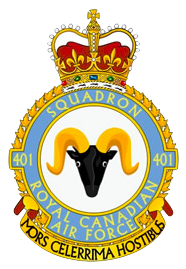
Badge: a rocky mountain sheep’s head. The mountain sheep is known for its great stamina and fighting power and is indigenous to the Rocky Mountain region of Canada.
“The history of 401 is one of many “firsts”, it originated as a fighter flight at Camp Borden, equipped with Siskins. Moving to Trenton in September, 1931, the flight became No. 1 (F) Squadron in March 1933. In August 1938 the squadron moved to Calgary and early in 1939 exchanged its long-obsolete Siskins for new Hurricanes. At the outbreak of the war it was mobilized at St. Hubert and subsequently amalgamated with No. 115 (Auxiliary) Squadron of Montreal before going overseas in June, 1940.
No. 1 Squadron, RCAF arrived in England in June 1940, going to Middle Wallop were it was equipped with the Hawker Hurricane Mk I. In July the Squadron moved to Croydon and in August the Squadron moved to Northolt, seeing action during the Battle of Britain until October, when it withdrew to Scotland to rest. It returned to Digby in March 1941, where it was renumbered No. 401 Squadron to avoid confusion with No. 1 Squadron, RAF.
In May it was re-equipped with the Hawker Hurricane Mk II. In September these were replaced with Supermarine Spitfire Mk IIs, and later in October of the same year by Supermarine Spitfire Mk Vb’s when the unit moved to Biggin Hill. During early 1942 the Squadron flew from Gravesend and Eastchurch, where in July some of the first Spitfire Mk IX were received. Operations with these aircraft continued from Martlesham Heath, Biggin Hill, Lympne and Kenley.
The squadron took part in operations over Dieppe on August 19. In January 1943 (shortly after the death of Sergeant Pilot William Ferguson) the squadron withdrew to Catterick to rest and was equipped again with the Spitfire Mk Vb, which were retained when the unit resumed operational flying from Redhill in July, and Staplehurst in August. Upon returning to Biggin Hill the Squadron gave up its Mk Vb’s in exchange for Spitfire Mk IX’s as the Squadron became part of No. 127 Wing and the 2nd TAF (Tactical Air Force).
Operations prior to D-Day were flown from Tangmere, and on June 18 the Squadron moved to French soil, one of the first squadrons to due so. As part of No. 83 Group the Squadron saw much air superiority work above the beachhead throughout the summer and then over Nijmegen in September. Although carrying bombs in the tactical fighter role, the Squadron regularly encountered the Luftwaffe and regularly added to it score. On 5 October five of the Squadrons pilots claimed the first Me 262 jet shot down for the Commonwealth Air Forces, while during New Years Day attack of January 1945 by the Luftwaffe, the unit was able to claim nine of the attackers shot down. Just as the war was about to end, the Squadron received some Spitfire Mk XIV’s, but the hostilities ceased before they could be employed. Despite this, the Squadron ended the war as the 2nd TAF’s top scorer, having claimed 112 aerial victories between 6 June 1944 and 5 May 1945; this raised the total for the war to 186 1/2, 29 of which had been claimed during 1940 when the unit was operating as No. 1 RCAF Squadron. The code letters carried by the Squadron during this period were YO.
Disbanded overseas in July 1945, the squadron was reactivated as an Auxiliary fighter unit – No. 401 (City of Westmount) Squadron. Continuing in the auxiliary role the Squadron later converted tot the CSR-123 dehavilland Otter and with a change in role to that of a light transport Squadron. With the retirement of the Otter aicraft most auxillary Squadrons converted to rotary wing units equipped with the CH-136 Kiowa in the Light Observation Role. In the early nineties the the Kiowa, along with the Huey and Twin Huey were retired and No. 401 Squadron was again disbanded.”
Battle Honours
Battle of Britain 1940, Defence of Britain 1940-41, English Channel and North Sea 1942, Dieppe, Fortress Europe 1941-44, France and Germany 1944-45, Normandy 1944, Arnheim, Rhine
Aircraft
- Hurricane I (April 1941 – May 1941)
- Hurricane IIB (May 1941 – September 1941)
- Spitfire IIA (September 1941 – October 1941)
- Spitfire Vb (October 1941 – August 1942)
- Spitfire IXC (July 1942 – December 1942)
- Spitfire VC (December 1942 – October 1943)
- Spitfire IXC (October 1943 – April 1945)
- Spitfire XIVE (May 1945 – June 1945)
- Spitfire XIVE (June 1945 – July 1945)
- Harvard
- Vampire
- T-33 Silver Star
- Sabre
- C-45 Expeditor
- CSR-123 Otter
- CH-136 Kiowa
Squadron Code YO – _
Achievements
- Sorties: 12,087
- Operational / Non-operations flying hours: 17,211 / 13,747
- Victories: Aircraft:
- 195 destroyed, 35 probables, 106 damaged
- Victories: Ground:
- dropped 278 tons of bombs
- Casualties: Operational:
- 61 pilots of whom 6 were killed, 28 presumed dead, 18 PoW, 9 evaded capture
- Casualties: Non-Operational:
- 10 killed
[Source: wikipedia]