My Memories of the last few months of WWII
Johanna (Anne) Pelkman
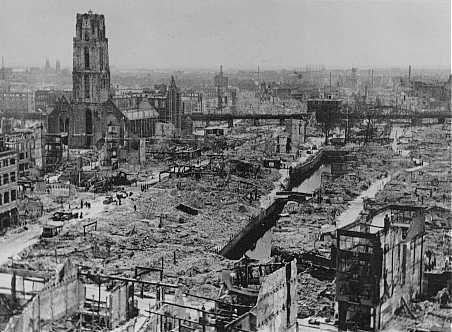
The last few months of World War II were very hard for the Dutch people, especially for those living in large cities like Rotterdam, where I lived. Food rations were getting smaller and smaller and people had to line up for hours, hoping they would not run out of food. Hydro was cut off as was the gas. People scrounged for wood wherever they could find it. Since there was no transportation, people tore up the wood between the tram and train tracks and they scoured the bombed out houses for any wood. Our neighbors around us had upstairs bedrooms, and they burned every other stair step and tore down the wood around the doors and windows for heat. Schools had been closed the year before to conserve energy, so we stayed in bed a lot to keep warm. There were always curfews if the underground fighters have been active and we would be grounded at 6 o’clock in the evening. Sometimes they would just take random people off the street cock, shoot them right there and then, and the soldiers would make us walk past them and look, as a warning.
Our household fared a little better. My father, who had worked for a leading Rotterdam newspaper for many years, was forced to work at printing propaganda papers, which we had to deliver. The benefit was, that my father, in cleaning the presses with newspapers, could take home the dirty papers full of ink, which burned very well. The downside was, that it created a lot of soot. My father had to clean our chimney regularly, which meant removing the stove and pipes and go on the roof with a ball and chain. My mother would be holding a gunnysack to catch the soot. I remember one time the bag overflowed, all over my mother and the floor. Luckily my parents had been saving a little petroleum to rub our head with, for lice control and that did the trick.
During Christmas holidays in 1944 my Dad brought my two sisters to farmer friends who lived in Friesland, in the north of the Netherlands, where things were safer. My older sister was not willing to go unless she had a pair of slacks. My father’s sisters, who sewed, donated old material and thread and my father and I made my sister a pair of slacks out of eight dark colored pieces of material. Miraculously they fitted and at least kept her warmer. My father had my 10-year-old sister on the back of his bike and my 18-year-old sister had a bike my father managed to put together from old parts. So they left on two bicycles with wooden bands on the rims, in the snow. It was hard for all, would we see each other again, we were silently thinking. The trip was full of dangers as they never knew what the existing curfews were in the areas they were biking through. In fact, one evening in a small town, a kind German officer put them in jail for their safety, after my sister started to cry when some soldiers came with drawn guns wanting to shoot us, they were celebrating a victory. Father and sisters made it safely to their destination in five days, after several harrowing episodes. The friends agreed to keep my two sisters. On the way back though, my father, I’ve been given lots of food to take home, collapsed from exhaustion, just before entering Rotterdam. Someone found him in the snow with his bicycle and food, took him home and let him sleep. My dad was so grateful, he shared the food he had been given. My mother was so glad to see my father back safely. This then was the scenario for my family in those last months.
My dad’s twin sister had a daughter named Ida, my age, 15 years. They had friends in the province of Gelderland. Ida wanted to go there, but not alone. So after much deliberation, my parents decided to let me go with her, and plans were made. Of course we could not contact the people and ask for permission to stay. Dad put on wooden bands around the rims of our old bicycles and we packed whatever clothing we head. Our parents gave us $100 each to wear under our clothing and around our necks, and for three days’ pancakes. How our parents somehow had scrounged the ingredients together I never did find out. My parents often bartered their pretty things for food.
We left early in the morning, on February 23, 1945, never knowing if we would see each other again. It was a cold, dreary day. Wet snow had fallen and made the road messy and difficult to manage. Constant traffic of German tanks and war equipment was heading to the Rhine River, along with German soldiers on foot and on motorbikes. It made us very apprehensive. Since all of our radios were confiscated we had no idea we were heading for the dangerous war zones. Often English fighter planes would fly over, intent on hitting the tanks and guns. Then we would try to find a ditch or bush for cover, or dive right in the snow and mud on the side of the road. By midafternoon we were exhausted and had not progressed as we had hoped, with all that traffic on the road. But the thought of our parents, who had practically no food, made us persevere. We gave ourselves a stern talking to and carried on. We were not alone on the road. Besides the German soldiers, there were many citizens like us, fleeing the city. During a rest now and again we talked to some of them, asking for information on where to sleep. Apparently there were farmers near the roadside farther up, who had opened their barns for everyone out of the goodness of their hearts. So we journeyed on and by dusk we found one of the bars. The farmer had spread straw on the floor and everybody just lay down as they came in. We ate one of our pancakes, very secretly, so no one would steal our little bundle. We took off our shoes, hoping our socks would drive, since our shoes were only wooden bottoms with rubber straps.
We have outgrown our shoes and much of our clothes several years ago. In spite of our primitive sleeping quarters we slept well, because we felt quite safe. The next morning, we left early, to beat the crowd. The weather was not much better. We were hoping to cross the “Lek” river. That was an important part of our trip. Once you crossed over that bridge, the trip was less dangerous, as the military goal seemed to be the Rhine River. With less traffic and English planes in the sky looking for tanks and trucks carrying large artillery, we made better progress. It snowed quite heavily that day, making it difficult to pedal our old bikes. Sometimes we despaired of ever getting to Eefde, our destination in Gelderland. We were tired, cold and wet. There was one highlight in the second day though, an unbelievable blessing that lifted our spirits. We met a man, who had a flat tire, a real tire! He saw that my bike still had the pump and asked if he could use it to pump up his tire. He promised us an egg . . . a real egg. We had not eaten one for several years. I said of course he could use my pump, but I sure did not believe the promise of eggs. Who would ever give away something so precious to two girls, who must have looked a sorry mess. But sure enough, he gave us each an egg and went on his way. There we were, two young girls in the snow, each with a raw egg. Somehow we packed our treasures safely away, with the plan to stop at the farm and ask if they would cook those eggs, knowing that that might be a hardship if the farmer did not have enough fuel for himself. After we gathered our courage, I knocked at the door of a nice-looking farm. The lady took one look at us and wanted to close the door. But I pleaded with her, saying we were on our way to Eefde and this stranger gave us these eggs for the use of my bicycle pump, and how we had not eaten an egg for years. And wood she, oh please, please, boil them for us. She relented, took the eggs and slammed the door in our face, leaving us shivering in the snow, and wondering if we would ever see those precious eggs again. But she came back with our eggs boiled, we could hardly hold them they were so hot. When I asked her if she could spare a little salt, she slammed the door shut again, never saying a kind word. We were happy with our precious gift though, and we ate our egg on the side of the road scooping up snow for a drink. That second night we also slept in a barn, but under better conditions. We ate our second allotment of pancakes and went to sleep. On the third day we saw fewer German soldiers on the road and people were kinder. It was farmland and people were not desperate like in Rotterdam. The weather was cold, but almost sunny and our clothes dried as we biked in better spirits. We arrived at our destination by late afternoon. We had asked several people how to get to the Velkman farm. The Velkmans were most surprised of course to see two young girls, totally exhausted and not exactly tidy, knocking at their door. They were kind people, promised to keep my cousin Ida and go around with me to his friends the next day. The mother of the house gave us water and a towel to cleanup and for the first time in three days we slept in our pajamas. Once in bed, we ate our last pancake, feeling so good for the time being.
The big question though was still hanging over my head. Would someone be willing to take me in. In spite of this uncertainty I slept reasonably well. We still had our hundred dollars intact. Mr. Velkeman took me around after breakfast, pleading my case, but had no takers, with the same result after lunch. I said I could work for my keep, but one look at me told them not to expect miracles. The people from Rotterdam had a bad reputation for stealing, mostly food. And since I did not particularly look my best, having biked for three days in snow in ill-fitting clothes, people were scared to take me in. But his immediate neighbor, a Mr. Lubberding with a large family, must have said, if Mr. Velkeman was stuck with me, to bring me over. So in the late afternoon, on February 26, 1945, Esther Velkeman brought me over and I had a home. It was my 16th birthday that day. It was a humbling experience, being so rejected all day long. I cried a little in my bed that night, wishing I could let my parents know I was safe, and hoping they were safe. I was not to know till July, when the Red Cross took me home.
My stay with the Lubberdings was a good time for me on the whole. They had a large family, two girls and five boys. The youngest was 17 and an accomplished organist. I did light housework and was free after 4 o’clock in the afternoon. They saw I was not strong enough to help on the farm. I was told later that they all looked in amazement at the amount of food I managed to eat the first two days. Not for years had I seen so much food on the table. I had taken my English and French textbooks, trying to recoup what I had lost in the two years of no schooling. I would find a nice spot outside or in the barn if the weather was good and study. There was a nice lane between the two farms, so why would often meet with my cousin Ida. I had offered Uncle Lubberding, as I called him, my hundred dollars for my keep, but he smiled and said to keep it, he was not a poor farmer. They gave me a pair of wooden shoes like the ones they wore. For a city girl, wooden shoes are hard to wear, but I managed.
As it turned out, the farm was in harm’s way during the final fighting in May 1945. The English tried to destroy the German holding near the river, but miscalculated. For a week the fire bombs fell on and around the farmland where I was. We lived for that week in the cellar, with the cows mooing for not being milked in time. Often, milking was down in a lull of the fighting or on evenings in the dark. One of the sons was not home, he was visiting his girlfriend. They were caught with several friends in a crossfire while outside. They all laid down under a tree, the only one killed was the girlfriend of the Lubberding son, although she was in the middle of the group. Eefde was not all that far from where the Canadian troops fought so hard. This area was the last holding of the Germans, who were holed up in an old castle nearby and threatened to flood the whole area by destroying the dikes like they did in other parts of the Netherlands. Our soldiers did not only fight the German army, but also the road conditions. All that rain and snow had made the roads one mud bath. Their heavy equipment had to be bodily or with horses hauled out of the mud time and time again. But the war finally ended on May 10, 1945. I saw my first Canadian soldier on the little lane between the two firms. It scared me so much, I stepped out of my wooden shoes and ran home on my socks. One of the boys later retrieved them for me, under great hilarity. The people in the cities went wild with joy and crowded the trucks and tanks and threw flowers as they drove through the towns, checking the destroyed homes for any stray German soldiers who were still shooting at times. Since the Lubberding farm was in the country, we did not see all the hoopla. The Lubberdings were very good to me, they even bought me a new dress, a pretty dress that fitted.
Late July, through the Red Cross, I was able to get a ride to my home in Rotterdam. I was anxious to find my parents. There was still no communication possible, so they did not know I was coming. Luckily my Mom was home, my grandmother was visiting for the day and when later Dad joined us, it was a happy reunion. My 2 sisters came home in August.
The food situation became a little better. Planes from as far as the Scandinavian countries dropped many food packages, bread and milk powder. We were also thankful that we had survived the war. My father biked to do Gelderland shortly after the war to visit the Lubberdings and thank them for taking care of me. It took the Netherlands several years to recuperate from this ordeal. Especially the housing shortage was a problem. In September 1951 I married my friend Martin Pelkman. We knew it was impossible to obtain an apartment. That is why we immigrated to Canada.
In July of this year I visited relatives in the Netherlands with my son Steve. We also visited the Lubberding farm. I had always stayed in contact with the Lubberdings and had visited them on previous visits. It was the grandson who now lives on the farm with his wife and family. We had a wonderful afternoon with them. One of our visits was to Groesbeek, where one of the large Canadian War Cemeteries is situated, not far from where they fought so hard. Over 3000 mostly young soldiers are buried there, some died just the day before Armistice. Another thousand names are engraved on copper panels lining several walls, for the soldiers whose bodies were not found but had died in battle. We walked around the graves with a thankful heart for the sacrifices they made.
Anne Pelkman – November 2013.
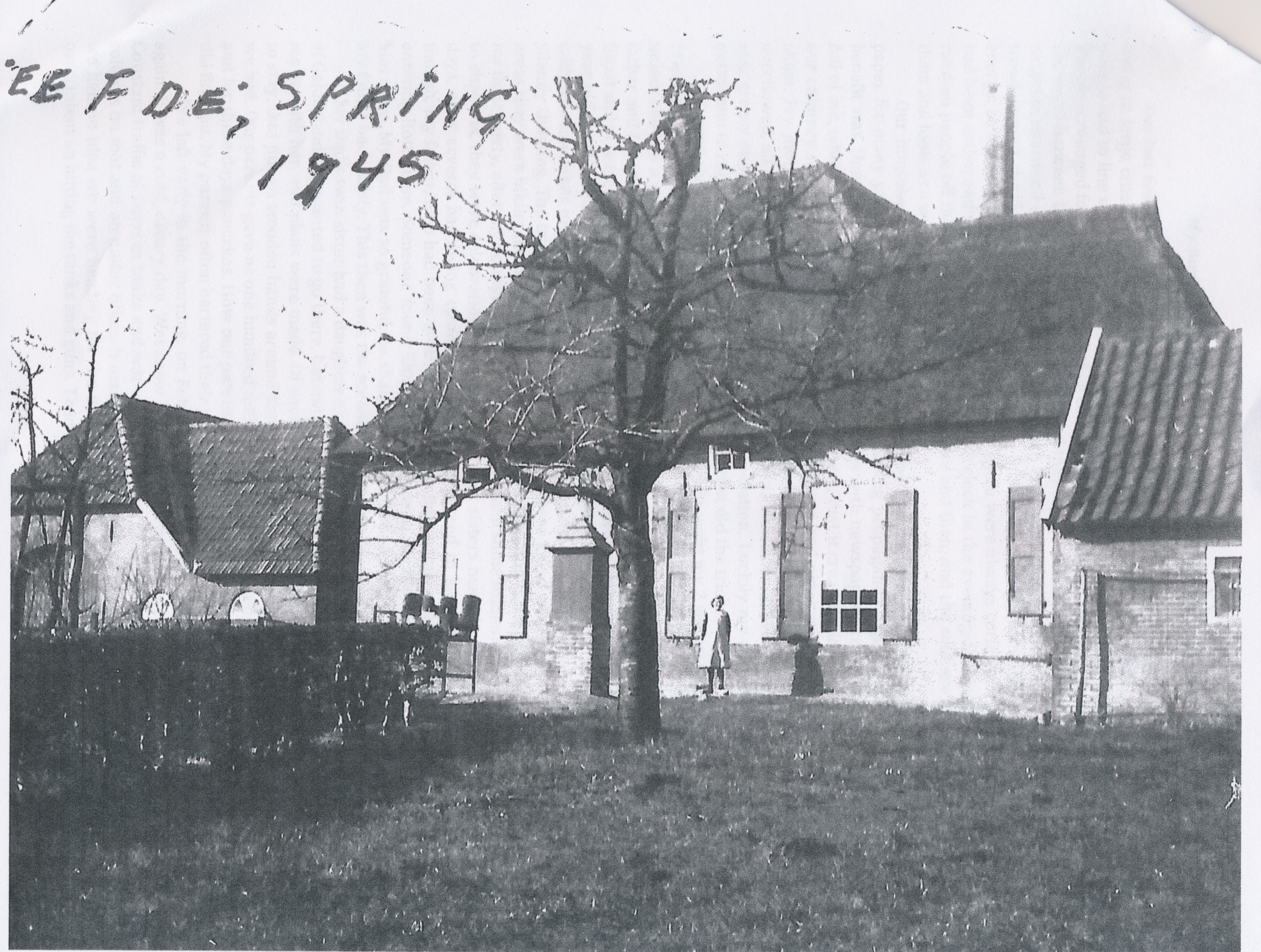
Photo above is from Anne
Photo below is from Google