
1916 had been a difficult year for the Allied armies in France. A combined Allied attack on the German fronts was to be undertaken by the French, Russian, British and Italian armies. The British and French were to attack at the Somme and draw German forces away from the Russian and Italian fronts. During the Battle of the Somme, which took place between July 1st and November 18th, 1916, on both sides of the upper reaches of the River Somme more than one million men were wounded or killed. In November 1916 a planning conference was held at the French General Headquarters and it was decided to make 1917 a decisive year for the Allies.
In November 1916 a planning conference was held at the French General Headquarters and it was decided to make 1917 a decisive year for the Allies. There were to be offensives all around the perimeter held by the Germans. The French, British, Italians, and Russians were to all strike in one battle. In fact, the Italians were too weak to attack, the French army attacked and then mutinied, there was a revolution in Russia, and the Americans joined the war (but weren’t yet ready to provide concrete action).
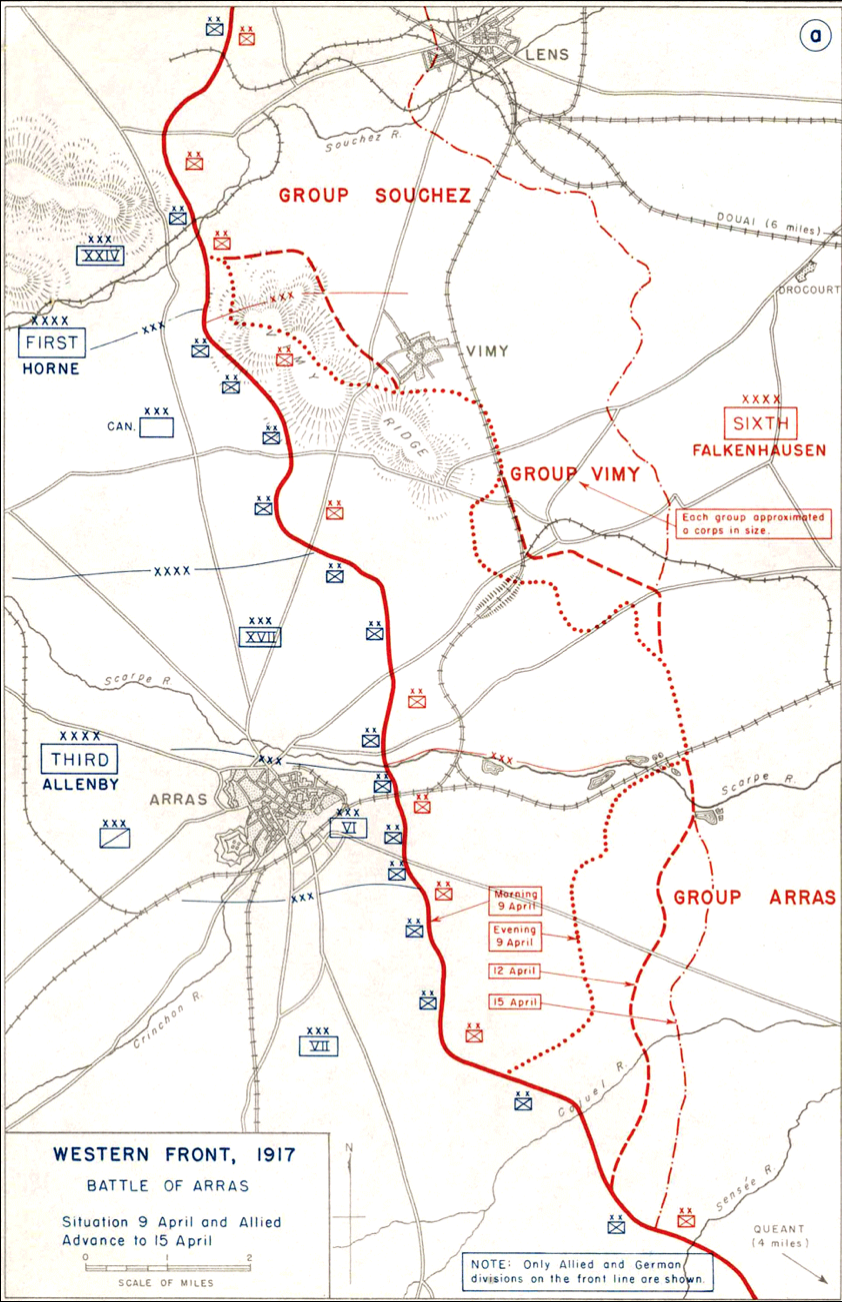
On the western front, the British were to attack out of Arras, while the Canadians were to secure the British flank by capturing Vimy Ridge. This operation was designed as a feint to draw German reserves from the areas further south where the French were to attack. Then Alexander Haig would transfer his forces north for the main attack out of Ypres to capture the Belgian coast. [This battle became known as Passchendaele.]
Between the time of the planning in November 1916 and the battle, the French had changed their commander-in-chief from Joffre to Nivelle. Nivelle’s plan was to take advantage of a bulge from the Somme to the Aisne, in the German lines that formed a large salient 50 miles deep into France. A direct attack on the head of the salient was thought to draw German reserves into the bulge to defend its ground, then a second offensive was planned on the base flank of the salient to squeeze the German defenders into confusion and elimination.
However, the Germans wanted to preserve manpower and so they simply moved backward out of the salient and formed a strong defensive line along its previous base. This became known as the Siegfried Stellung, or Hindenburg Line. This maneuver had taken the whole point out of the attack by removing the weakness and replacing it with a formidable defensive line. As the Germans had retreated they had left a desolate, booby-trapped wilderness through which the Allies had to advance slowly to regain contact at the new front. Instead of rethinking the whole plan, Nivelle stubbornly persisted and basically destroyed the French army in the subsequent battle. This stubborn persistence with foolhardy plans, and ignoring alternative options, resulting in massive casualties was far too common in WWI.
Never-the-less Vimy Ridge still had to be taken as it was not included in the German withdrawal. Rather, Vimy marked the northern hinge of the retreat, and thus ‘according to plan’ the Arras-Vimy offensive was still designed to draw German reserves away from the areas to be attacked by Nivelle.
The offensive began on April 9th, 1917, continued until May 16th, 1917, and was given several names. The British called it the Battle of Arras, the Germans know it as Die Osterschlacht bei Arras. It is also known as the Battle of the Scarpe, from a small river that runs through Arras. Regardless, the attack on Vimy Ridge was just one small part of a larger logistical offensive. The Canadians were to attack, hold it, and move no farther forward. The rest of the First Army (of which the Canadians were a part) was to advance past the Ridge, guarded on its flank by the Canadians on the Ridge, and then across the Douai plain, and the Third Army was to break through to the east of Arras and advance toward Cambrai.