

Background
The German army in France depended upon using existing rail lines to transport its war munitions, men and support supplies. Whoever controlled the rail lines controlled the fastest flow of equipment for supply and reinforcement. The commander of the British Expeditionary Force in France, Field Marshall Haig, selected the area east of Amiens, France as vital to securing for the Allies the rail line running from Paris to points north.

Order of Battle
British Expeditionary Force in France – Field Marshall Douglas Haig
4th British Army – General Henry Rawlinson
Canadian Expeditionary Force 1st Division – General Arthur Currie
3rd Brigade – Brigadier General George Tuxford
14th Battalion – Lieutenant – Colonel Richard Worrall
+ Sergeant Henry Charles Byce
Overview
“The Canadian effort on the Western Front, where the Canadian 1st Division arrived in February 1915, is always associated with the offensive on Vimy Ridge in April 1917 and more generally with the Third Battle of Ypres (Passchendaele). . . . Canadian troops were at Ypres in April 1915 and Amiens 1918, but perhaps their greatest achievement was during the Hundred Days – between late August and October 1918 – when they breached the defenses of the German Hindenburg Line.”
[“World War I”, H.P. Willmott, page 209[
“On August 8 the British Fourth Army mounted an attack in front of Amiens with 465 tanks. In just one day the German front was broken over 15 miles (24 km). Six weak German divisions were destroyed, with the British taking 13,000 prisoners and 400 guns. To the south, the French First Army slowly advanced 3 miles (5 km) over a similar frontage before grinding to a halt.
“The results achieved by the Fourth Army were little different from those registered on the first day at Cambrai in 1917. But in front of Amiens, the Germans’ defeat was marked by a collapse of formations which led Ludendorff to describe this as “the black day of the German army”. Nonetheless, the German high command was able to respond quickly and effectively to this defeat. By midday on the second day, nine German divisions had been fed into the line. The British, with 145 tanks, advanced just 3 miles (5 km). On the third day of the offensive, when just 67 tanks remained in service, the only gains made were in the center and to a depth of about 1 mile (1.5 km), at which point the British offensive was brought to an end.”
[H.P. Willmott, page 263]
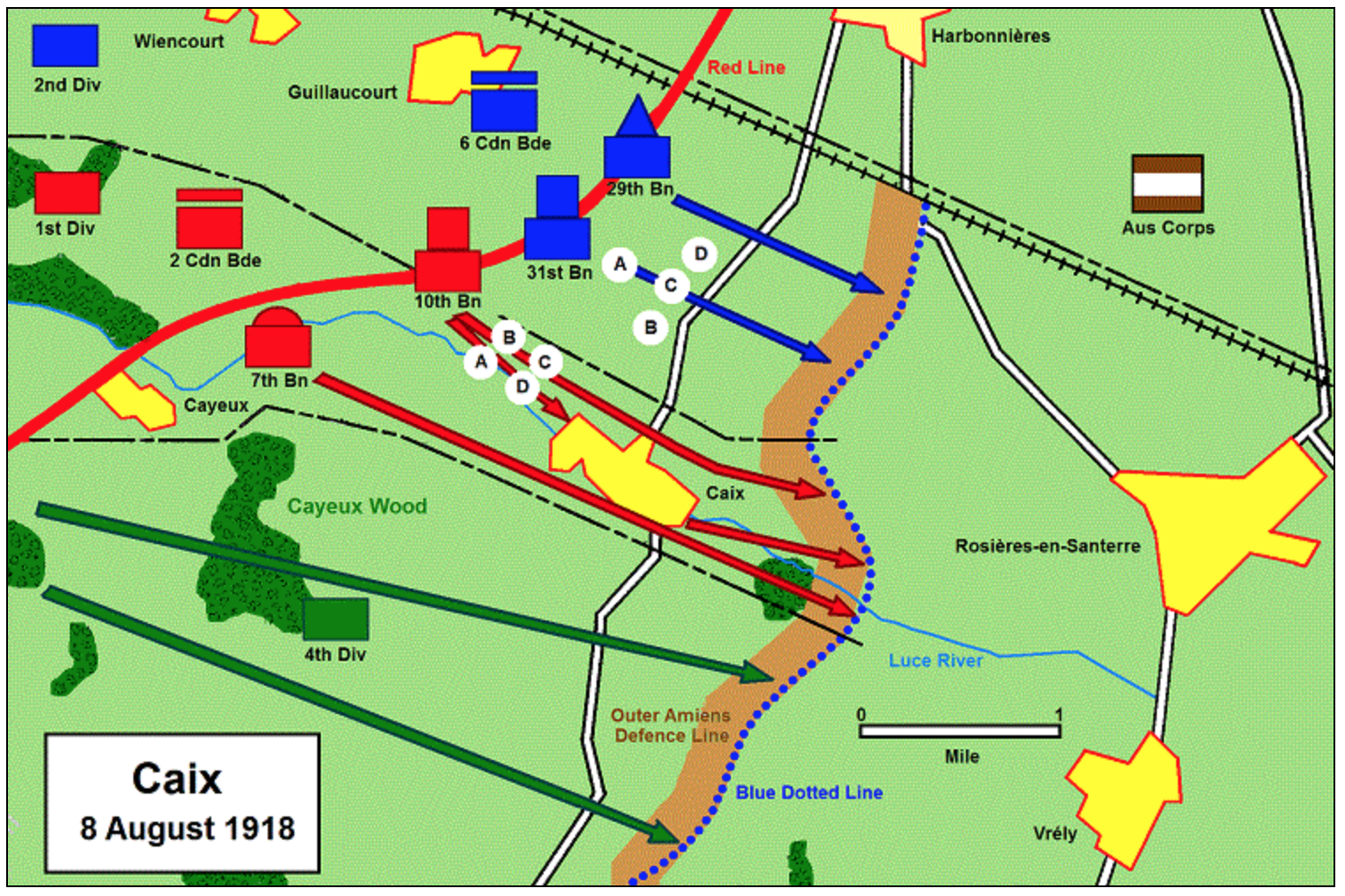
“The main attack, by five Australian and four Canadian divisions, scheduled for 8 August, was to go in without a preliminary bombardment. French attacks also planned for that day were being conducted with a preparatory barrage. For the Canadians and Australians, a rolling barrage would start at Zero Hour, [4:20 am] with tanks crashing through the enemy’s front lines, as had been done at Cambrai. Three objective phase lines were marked out; the German front line (Green Line), the reserve and gun lines (Red Line), and a final line far to the enemy’s rear (Blue Dotted Line). The artillery planned elaborate counter-bombardment measures to prevent German artillery from hindering the attack.”
[Excerpts from Calgary Highlanders, 10th Battalion ]

“Each of the 1st, 2nd, and 3rd Canadian Divisions were scheduled to attack with a single brigade up, a second brigade to move into the line as the front widened, and a third brigade in reserve. The 4th Division remained in Corps reserve with the cavalry, earmarked to leapfrog ahead once the advance passed the Luce river upon the 1st and 3rd Divisions reaching the second phase line.”
Henry Byce was a member of the 1st Canadian Division, 3rd Brigade, 14th Battalion, and his route followed the dotted line on the map above. The 14th Battalion moved forward (east) as far as the red line before being leapfrogged by the 2nd Brigade.
“The night of 7-8 August was fine with no moon. There was a tense air of expectancy as the troops earmarked for the assault moved up under cover of darkness to their assembly area. On the Canadian Corps right the 3rd Division relieved an Australian brigade at 2:00 a.m.; it was four o’clock, only twenty minutes from zero, before the last of General Lipsett’s attacking units were in position. By that time a thick ground mist had begun to form in the valleys, blotting out visibility even after the sun had risen. The supporting tanks began to move forward at twelve minutes before zero from positions one thousand yards behind the front. To drown the hum of their engines – running as quietly as possible in second gear – the artillery maintained a normal harassing fire, and a large bombing plane droned noisily up and down above the forward trenches. Exactly at 4:20 the barrage opened with the thunder of more than nine hundred guns and immediately the assaulting infantry pressed forward. In the Luce valley, where the mist was especially heavy, the Canadians were hard put to it to keep pace and direction. The enemy’s barrage came down within a few minutes of zero, but thanks to the excellent counter-battery work of the British guns the German fire was generally erratic and not particularly damaging.
The 1st and 2nd Divisions were each attacking on a single brigade frontage, using a fresh brigade at successive lines of advance, but because the River Luce split the 3rd Division’s front General Lipsett employed two brigades in the initial phase. He crowded three battalions of the 9th Brigade and a company of the 5th Tank Battalion into the narrow bridgehead south of the river about Hourges, while on his left flank the 8th Brigade assaulted with a single battalion up.
The leading battalions advanced well deployed so as to reduce the number of casualties from the enemy’s fire. In general, each was disposed in five waves at intervals of one hundred yards. Skirmishers in the foremost wave of two lines, thirty yards apart, helped guide the tanks. The next three waves consisted of well-dispersed section columns in single file, and carrying parties brought up the rear. The infantry found themselves less heavily burdened than in former operations, for to meet the requirements of a prolonged yet rapid advance General Rawlinson’s staff had devised a modified “fighting order”* which eliminated some unnecessary weight and distributed the rest more evenly.”
[Nicholson]

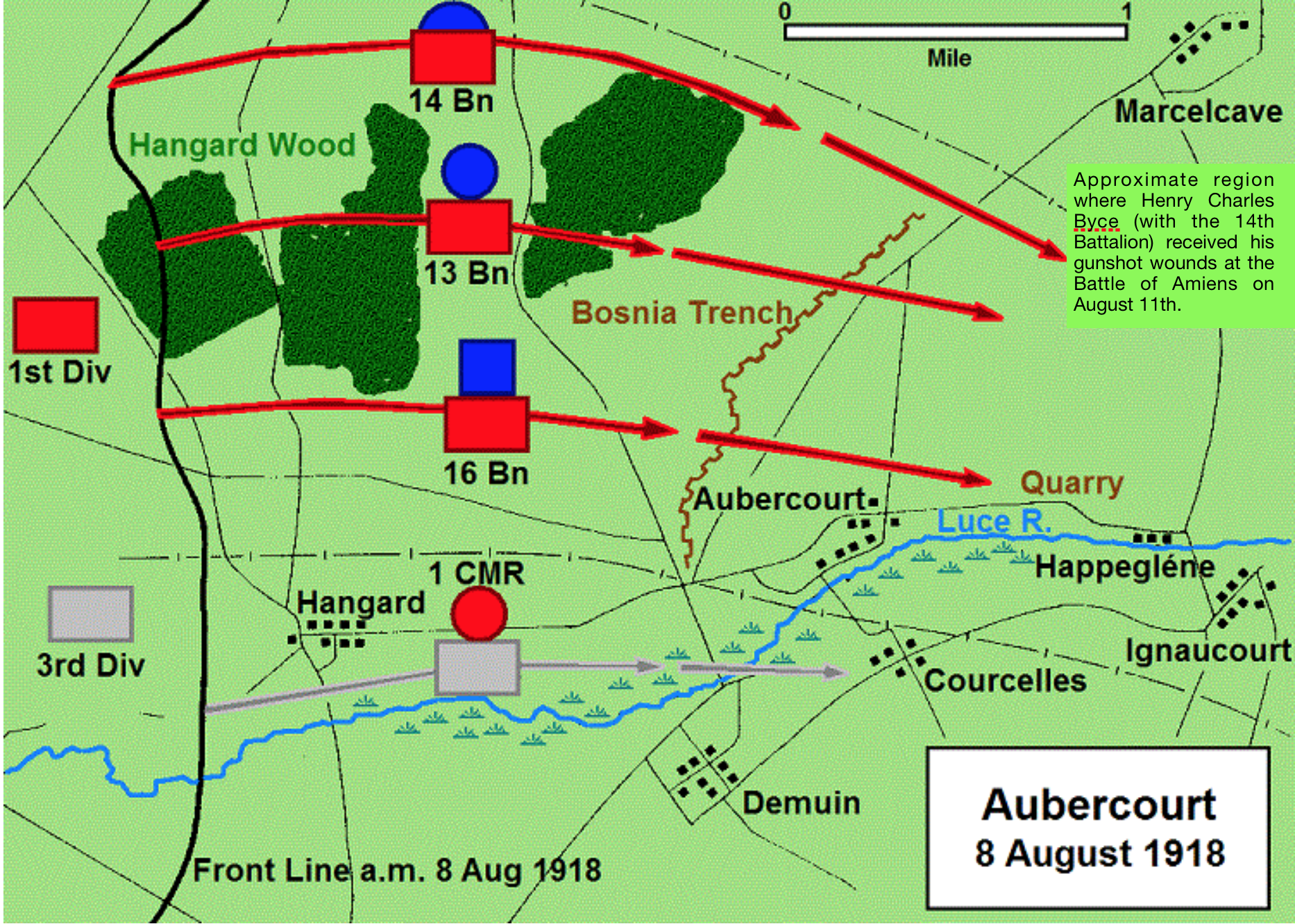
“As the fog began lifting in mid-morning, resistance began to stiffen, especially from enemy machine-gun crews. Four Canadians were awarded the Victoria Cross for actions during the Battle of Amiens, all for engaging enemy machine guns.
“Disregarding threats from flank and rear, the Canadians pushed quickly ahead. Small detachments which became involved in local actions left the mopping up for succeeding waves. So rapid was the advance that the 3rd and 5th Battalions, which theoretically were not involved in this stage of the attack, found themselves committed in sharp encounters with parties of Germans that had been by-passed. Twenty-five hundred yards from the start line fighting developed all along the trenches which formed the enemy’s main line of resistance in front of his artillery positions. It was here that Private J.B. Croak earned the first of two Victoria Crosses won that day by members of the 13th Battalion. Having attacked and captured a machine-gun nest single-handed, Croak, though badly wounded, later charged another German strongpoint and with the aid of other members of his platoon silenced three machine-guns, bayoneting or capturing their crews. Wounded a second time, he died just after the last resistance was overcome. Equally courageous was Corporal H.J. Good, of the 13th, in disposing of three machine-guns and their crews, and then with the assistance of three comrades, assaulting and capturing German battery of 5.9-inch guns and their entire crews.
In this second stage, the advance of all three battalions followed the same pattern. On several occasions they were held up by the fire of German machine-guns advantageously sited on the high ridges or concealed in the small woods that interspersed the grain fields. Before their tanks caught up, the infantry had only the support of their own Lewis guns in dealing with these. Canadian casualties were light, most of the losses coming from German artillery fire. By eleven o’clock the 2nd Battalion, south of the Luce, had reached its objective and established outposts on the high ground east of Cayeux. In the centre the 4th Battalion, advancing astride the river bed, cleared Cayeux without meeting much opposition; while on the Brigade left the 3rd Battalion, having run into trouble in the deep ravines that entered the Luce valley from the north, made good its portion of the Red Line by 11:30.”
“Sharp at 1 o’clock the 8th Battalion attacked, and simultaneously the 14th swung into position to support, the move involving a flank advance through a small wood, which was being subjected to sustained fire. The value of maneuvers carried out during the period in Army Special Reserve was demonstrated at this time, the company, platoon, and section commanders displaying marked ability in leading their men through the wood to the desired point on the flank.
“On debouching from the wood, the men of the Battalion suffered sharply from machine guns hidden in another small wood some distance forward. Grim evidence that the 8th Battalion had encountered similar fire was supplied by a number of dead, and a stranded tank gave warning that the infantry assault might lack mechanical assistance. Fortunately, the ground mist of the previous day was absent, and commanders could see what was taking place. In this instance, skillful leadership solved the problem, the garrison of the opposing wood being held in play on the front of attack, while strong forces maneuvered for position on the flanks. Eventually, the troops on the left gained a position, whence they launched an attack, supported by a tank which came back from a position far forward and attacked the wood on the right. Dismayed by this vicious onslaught, many Germans were killed and wounded, and over 50 taken prisoner.
“At this stage of the action Major Saunders, of the 8th Battalion, requested support for his left flank, which had suffered severely. Realizing that the flank in question was important, as it connected with the right flank of another brigade, Lieut.-Col. Worrall sent forward No. 3 Coy. of the 14th with orders to support the 8th Battalion in every way possible. Shortly after this, the Royal Montreal Regiment reached its assigned objective and immediately started to consolidate. While consolidation was in progress Lieut.-Col. Worrall and Capt. MacRitchie advanced to appreciate the situation in the forward area.
“After some time Worrall and MacRitchie reached a spot where some 60 to 80 officerless men of the 8th Battalion were used to prepare for a counter-attack, which could be seen massing in the direction of Fouquescourt. Simultaneously, a squadron of British cavalry trotted along the Meharicourt-Fouquescourt Road, obviously into a trap. Powerless to warn the horsemen, the Canadians watched them move to their fate. When they reached Fouquescourt Crucifix the enemy opened fire. Too late the squadron leader recognized his peril. Some of his men escaped; the majority sank to earth dead, dying, or severely wounded.
“Finding that the point reached by the foremost men of the 8th Battalion was unsuitable for defence, Lieut.-Col. Worrall decided to consolidate a short distance to the rear. Spreading the personnel of his Headquarters along the line selected, he sent runners back and ordered the main body of the 14th Battalion to advance without delay.
“By this time the enemy realized that his counter-attack was not to progress unopposed. Halting, therefore, he pushed forward machine gun posts, which inflicted losses on the men digging in. Whippet tanks advanced in an effort to subdue the machine gun fire, but the gunners were hard to find in the fields of nearly ripe grain. Two whippets were disabled before one machine gun nest had been destroyed, but other nests were silenced by the presence of the tanks, and consolidation was thereby assisted.
“When consolidation had made some progress, Major Saunders, of the 8th Battalion, arrived back at the front from 2nd Brigade Headquarters, bearing written orders in obedience to which the 14th Battalion relinquished the front line and withdrew to a support position about 300 yards to the rear. During .the night which followed the enemy attempted no further advance; instead he recalled his forward posts and retired, the 8th Battalion quickly recognizing his intention and pushing out patrols which established posts along the line of the Battalion’s final objective.
“On August 10th, 1918, the Royal Montreal Regiment lay in a support position not far from Warvillers. From this position, the men, for the first time, witnessed a charge by a British regiment of cavalry. Riding up in fours on the left, the horsemen formed into lines of squadrons and swept magnificently to the attack. Unfortunately, they encountered a shattering barrage of black-smoked 5.9’s and then ran into barbed wire. In the wire, the splendid unit was cut to pieces by machine gun fire.
“Unaware of what the future held in store, the 14th Battalion moved back on August 12th to the Beaufort Area, where the men occupied trenches about 300 yards in advance of the Beaufort Village Road. On August 15th Capt. D. MacRitchie, Adjutant, issued Operation Order No. 237, in obedience to which the Battalion moved forward at night to a position in the front line at Parvillers. Taking with them 193 new men, who had reported for duty from England, the companies relieved a battalion of the 7th Canadian Infantry Brigade without suffering casualties.
“At noon on August, 16th Brigade notified Battalion Headquarters that a German Alpine Division had moved into the line opposite and that minor operations might be expected. Later, in view of French successes near Goyencourt, all troops of the 1st Canadian Division were ordered to hold themselves in readiness for a sudden move. At 4 o’clock Brigade reported that French troops were driving the enemy from Goyencourt.”
Further description of actions by the 14th Battalion after the 16th may be found starting on page 227 of the document.
[The Royal Montreal Regiment 14th Battalion C.E.F. 1914 – 1925, Fetherstonhaugh, R.C., 1925]