
Hank Kielstra resides in Strathroy, as do his older brother, Cecil, and two sisters, Jean and Shirley. Cecil is named after his uncle. It is common among the Dutch for the eldest son to be named after an elder relative. Cecil Kielstra is an uncle of Cecil, Jean, Hank, and Shirley. He has summarized, for his family, his experiences during the period of the Second World War.
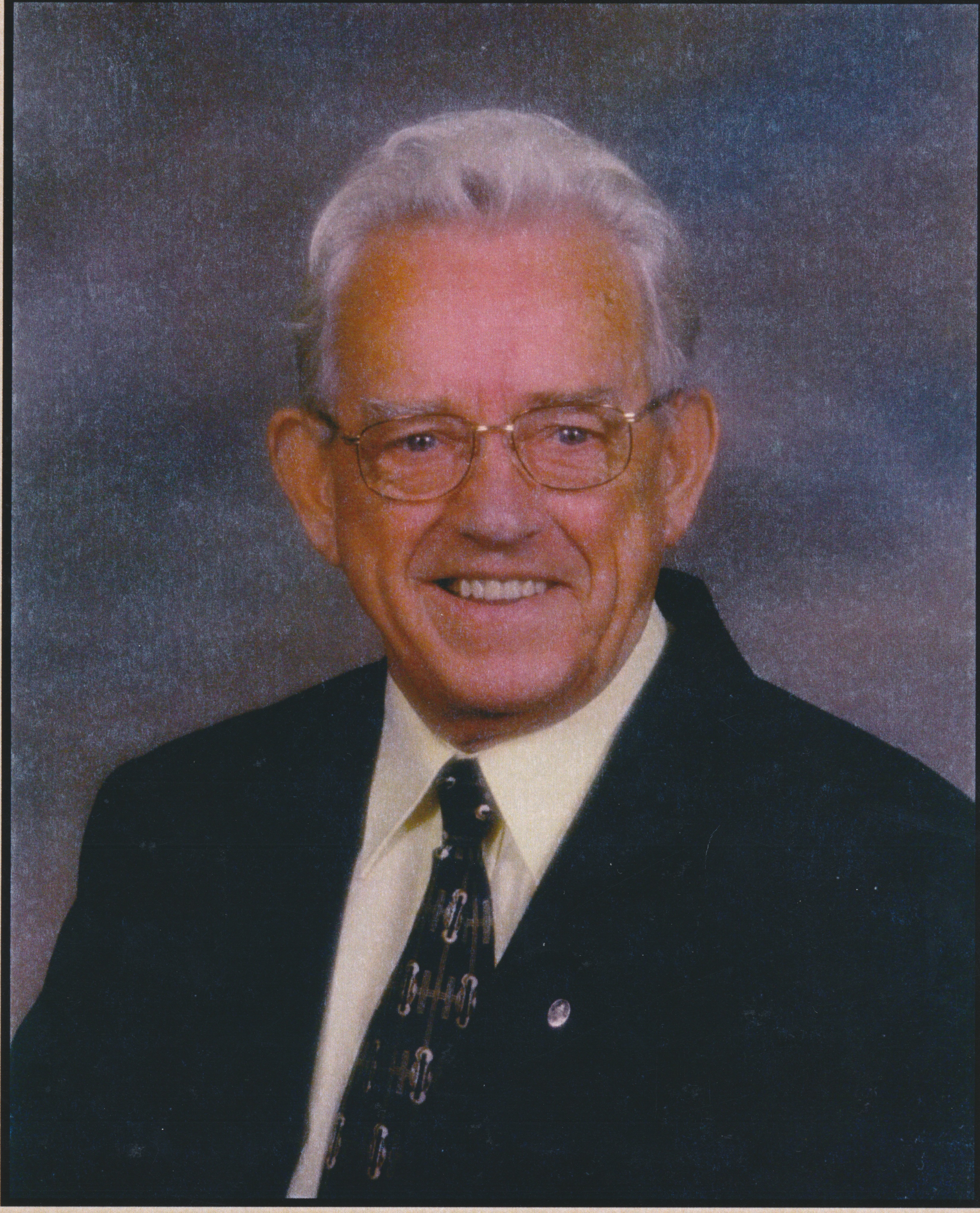
Cecil Kielstra was born on December 18, 1925, in a poor neighbourhood in the town of Surheisterveen, in the Province of Friesland, in the north part of the Netherlands. Cecil was one of 9 children who survived. A brother, Klaas, was the father of Hank, Jean, and Shirley.
The principal of the school where Cecil and Klaas attended asked their father to send them to high school as they were capable students. However, there was no money for that. In September 1939, Cecil was 14 and he was taken out of school and sent to work in a grocery store. “Labour laws were relaxed with the war looming over us and all over Europe.”
This is where Cecil’s own story takes over the narrative:
“Labour laws were relaxed with the war looming over us and all over Europe.”
“I earned 2.50 Dutch guilders per week for 5 1/2 – 6 days. Mother surely could use the extra income with so many mouths to feed. Every Saturday, she would give me a dime out of my pay. At the corner store, I’d spend a couple of cents for a small chocolate bar and I had some coins left over to jingle in my pocket at night when I met my friends who went to high school and had no spending money at all.
“In May of 1940, darkness descended over my home country, and to be truthful, we never knew how deep that darkness became until the end of the war. That day in May 1940, the Germans invaded Holland and with their superior weapons, it was a matter of a few days, we had to become “occupied territory”. The first Sunday of the war, our minister, the Rev. John Booy, had the congregation saying Psalm 39 of the Dutch Psalter. The first day of the war I remember well. German airplanes scouting out the countryside, flying at treetop level; the first army patrol wheeling into our town on bicycles with radio packs on their backs. There was no fighting of any kind. The area in which we live was no doubt not of any strategic value.
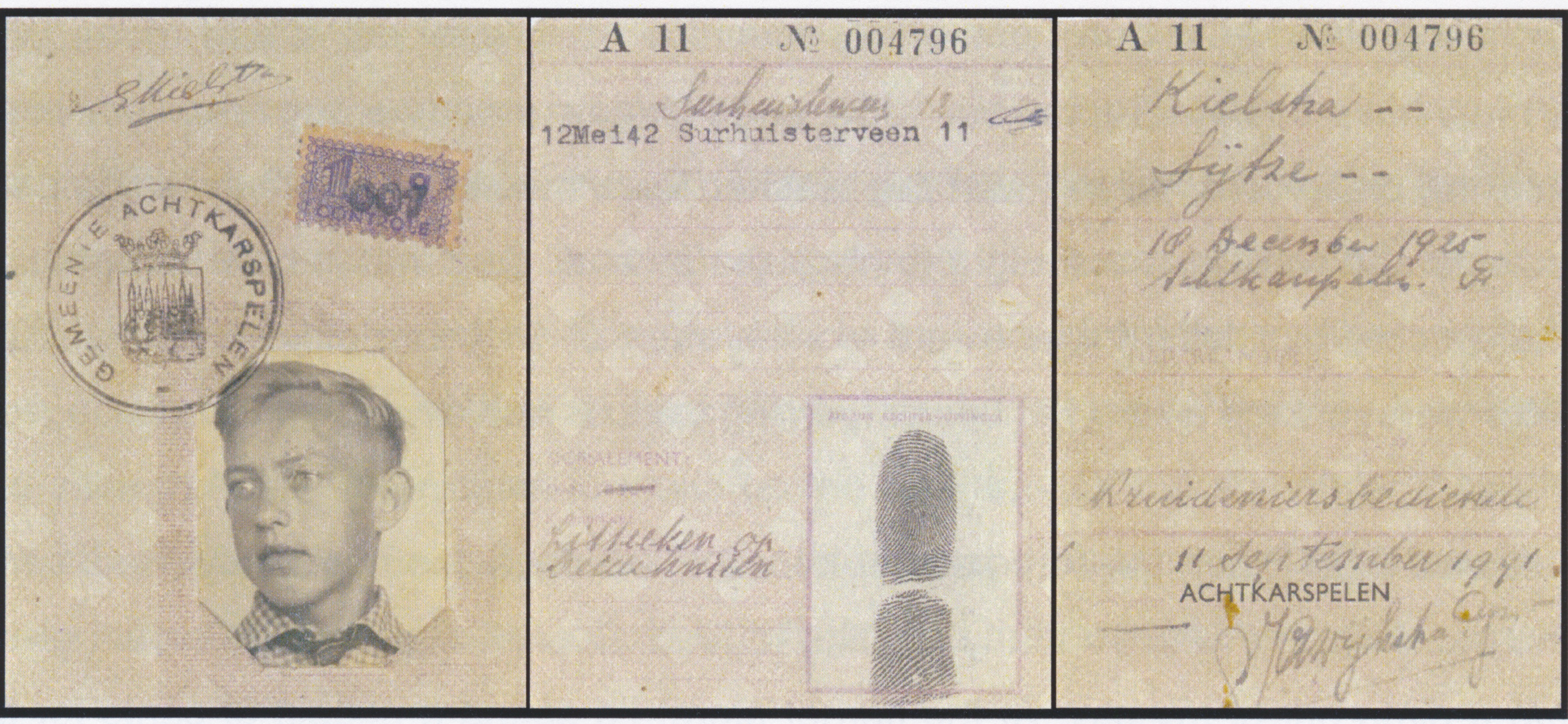
“The first couple of years of the occupation, nothing much happened. We lived on the edge of town in a peaceful fire area, at the border of the provinces of Friesland and Groningen. But gradually the squeeze became tighter. Everyone over the age of 14 had to have an identification paper with photo and fingerprint. Having this system in place made it much easier for the occupying forces and their Dutch collaborators to keep track of the population.
“There were very few automobiles in our town at that time. One of the cars was owned by the principle of the Christian school. It went “in hiding”, got buried in a haystack somewhere and was later used as a command vehicle by the local “underground army” during the last days of the war.
“Travel was limited for most of the populace. As gasoline became more and more scarce, the buses cut down on their schedule as well. Even bicycle parts, especially tires, we’re hard to come by. Toward the end of the war, many bikes were confiscated by German soldiers retreating to their homeland.
“Many of our people were forced to work in wartime industries in Germany. Brother Klaas was one of them. He worked in an ammunition factory which was bombed by the Allies’ Air Force. Under the cover of destruction, he and a friend fled and found their way home through many scary situations, like a river they had to cross. There was a guard on the bridge. Under cover of a severe thunderstorm, they overpowered the guard and eventually made it home and went into hiding like so many other people did at that time. Where did they hide? Mostly in the rural areas. Many farmers had one or two so-called “farmhands” living in their barns. Those young people worked for their keep. In most cases, the farmer did not need their services but took them in just to hide them from the enemy.
“Now and then, Klaas would come home for aweekend or so. On one of those trips, he was surprised to buy a bicycle patrol of collaboratorsand arrested. This was a chance encounter as the patrol was out to arrest someone else in a neighboring village. Is the patrol got to and raided the house of the person they wanted, Klaas kicked his guard where it hurts and took off of his bike. This surprised and hurt guard managed to fire a couple of shots but missed his target. A witness to this was our local doctor who stopped briefly at our house to tell us what had happened
“I was home at the time and as I had reached the ”danger age”, we did not want to take a chance on me being picked up as well. Other quickly made some sandwiches; I grabbed a couple of blankets and fled into the fields. We knew the area well; the farmers’ fields, the hedges, the creeks and whatever the landmarks, we could have found them blindfolded. The doctor told us about where Klaas had escaped and it did not take as long to team up. We stayed in the “fields closing quote for several days, sleeping in the wheat fields. Now and then, I would sneak home for some food and clothing.
“After a few days, the pressure was off and dad was able to make arrangements with people in our neighborhood who had a small chicken barn behind their house. The upper level could be reached also from the outside by way of a ladder reaching up to the small upper doors. After dark, we would climb in and pulled the ladder up behind us and we would leave the same way in the morning. Problem was that there were the chickens housed in the lower level and we soon were bothered by chicken lice. Other than that, we slept warm in our bed of straw. In our circumstances, we could not afford to be fussy.
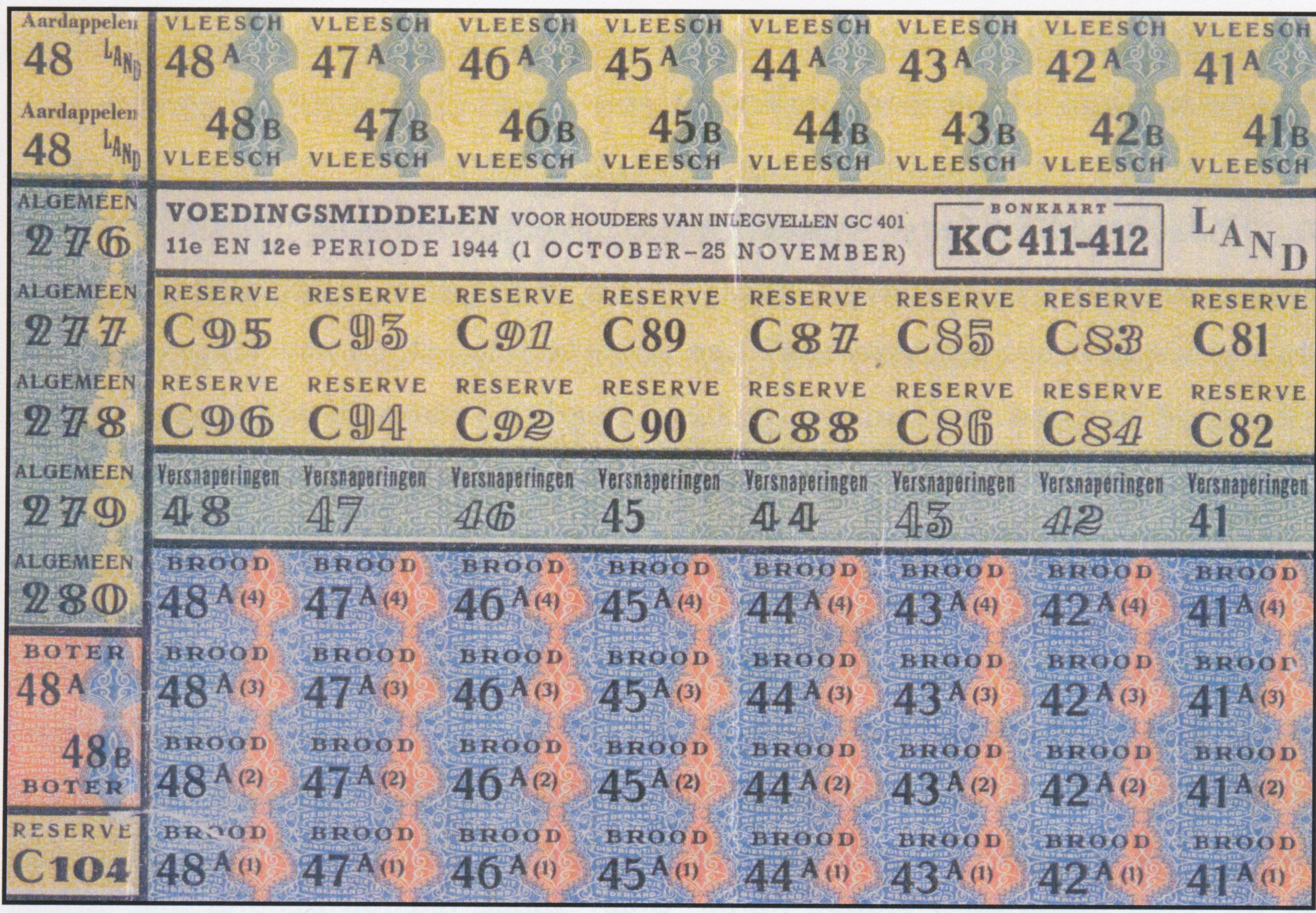
“As time went on, many things were hard to get. Most everything became rationed and coupons were issued, for food especially. Working for the grocery store, I was on the road a lot (by bike). Being from a large family helped out. Like, we had lots of sugar coupons and a farmer with few or no children did not have enough but had a lot for meats. I would trade a sugar coupon (1 kg) for say 1 kg of bacon and 1 kg of sausage from his illegally butchered pig (all births and killings of farm animals were strictly controlled but many farmers would conceal the birth of a lamb count, I calf or a piglet). Even though there was no money to spare, we usually had enough to eat.
“But some things were not just to be had as time went on and while writing and digging deeper into my memories, all sorts of things come back to mind. Much of it is ”small stuff” but important at that time. As I said, many people give us access to many things. Like the farmer’s wife who needed some extra sugar for canning. I gave her 1 kg of the sweet stuff in return for two of the Muscovy ducks swimming in their pond. The husband dressed them for me and I can still see the surprised look on my mother’s face when I brought them home, ready to cook.
“Another farmer desperately wanted some pipe tobacco. It was early spring and he had a number of young lambs in his field. I got him a pound of tobacco in exchange for one of his lambs with the agreement that it would feed in his field until fall. So, in the late fall, I came home with a nearly full grown sheep. Our neighbor, a butcher, helped us out and soon most of the meat was put in large glass jars, properly spiced, boiled and sealed, providing us with the richness of food that we had never experienced before.
“And then there was Anna, a farmer’s daughter. She did the housekeeping for her widowed mother, who was usually working in the barn. Anna also ordered all the groceries for the family and she preferred to sit on my knee while we discussed her in the family’s (grocery) needs. At times like that, we did not worry about the war talk. I was about 17 and she was about 15 or 16, and well put together. Sweet memories.
“As the war dragged on, many items became hard to come by. Soaps and other cleaning supplies were hard to get and we had a hard time keeping clean. Head lice were everywhere!! In many families, it became a routine that before going to school, the children’s hair was subjected to the special comb treatment and had to be done again after school hours. Even adults did not escape this terribly annoying thing. Many mothers cut their daughters’ hair short in those awful days. For a while, the drug store sold a lice-killing fluid which was very effective, but eventually, it too was no longer available.
“We lived across the street from a dairy farmer and we often helped the farmer doing his chores, especially mucking out the barn. He paid us with one large pail of milk per day. Mother would let it sit overnight and then skim the cream off the top. The cream from a few days was put in a home-made churning device. The churning resulted in particles of butter floating on the top. That gave us lots of butter and also provided us with a good amount of buttermilk, which was (and is now) very tasty and wholesome. Try it, you will like it!!
“As time went on, the Allies gradually gained air supremacy, and Allied aircraft, on their way to bomb targets in Germany, flew over our area almost at will. There was, however, a German fighter unit stationed about 30 km from us, and so-called “dog fights” occurred now and then.
“My neighborhood had built a bomb shelter of sorts. I am sure that it would not have survived a direct hit, but it was very solid in would have withstood shrapnel or gunfire. Toward the end of the war, Allied bombers were flying at a much lower level and came by the hundreds. You can’t imagine the noise! There was a constant heavy drone that made everything shake and the doors and windows rattled. It was very scary and we often went to the shelter just to escape the noise.
“But no matter what was happening, even in dire and dangerous circumstances, there were always people who created entertainment just by the way they are and act out. The very narrow entrance to the shelter was very hard on the manager of the local dairy. He was a short person and his stomach was “in the way” so to speak and often we watched some neighbors push through the narrow opening. Being teenagers, we could not figure out why some men had such big tummies. (We know now!)
“At that time, I must’ve been about 16 and my employer and I were on the road a lot. The once a fairly large horse-drawn wagon loaded with groceries (much like today’s delivery vans). The system was that the boss would go in the customer’s home to get the order and it was my job to fill the order and make the delivery. The once-a-week route was close to town. It was either Christmas Eve or New Year’s Eve and getting dark. I was delivering the last order on my bike. The boss turned horse and wagon around and left for home. I was soon done and followed. But a short distance away, I saw the horse grazing and the wagon in the ditch. I found Mr. Kooy pinned down under it. He was dead! What a shock that was, and what an experience for a young guy. His sister took over the business and life went on.
“Evenings and nights at the time were dark, not just dark, but dark, dark!! Not a ray of light was to be seen. Every family had so-called black paper curtains to cover the windows and of course, street lights were out of the question. Just drive out in the country sometime, to some out of the way place on a cloudy evening, turn off the car lights and step out. That is how dark it was where ever we’d go, even in the towns and villages. All were strictly controlled by irregular patrols. They did not want any allies flying overhead to use any lights as tools for navigation. Actually, the only light most people had was from home-made candles or coal oil lamps. Several dairy farmers in outlying areas had wind vanes on the roof and created a limited supply of power which was stored in batteries for use after dark. Lights only, of course. There was no such thing as milking machines or electrical equipment as seen on today’s modern farms. There was only deep darkness!! Curfew was 8 pm in in the winter time and very few of us ventured outside except visiting neighbours or friends living nearby and then only if we knew every foot of the way – you just never knew what patrol you might bump into.
“On one such evening, we were sitting in the living/dining room reading, with mother repairing socks or so. It was one of the few evenings that the hydro was on and we had some light to read by. Klaas had been home for a few days and one eveningvisited a girlfriend a few doors down the road.
“Suddenly the living room door burst open and when I looked up, there were three of the German security forces (with brass half-moon on their chests), guns trained on us. We just sat there, completely dumbfounded. The house was searched and they asked about Klaas. As for me, I had a fake letter from the government stating that I was essential in the food distributing and that kept me from being picked up. It was a dark and cold evening and dad went to the back door to intercept Klaas in case he came home. But alas, there stood a German guard. Dad, acting concerned, invited him out of the cold and into the warmth of the house. While all this was going on, Klaas came home and when he heard the Germans, he snuck into the bar where we had a hiding place dug out under the old horse stable. What a close call that was!! And dad got rid of the guards.
“More visits followed. One daytime raid was made by the hated collaborators with German C.O. (At that time, it was already decided that I should not stay at home anymore. Any man, aged 17 or older had to have a very good reason and documents to show why they should not be working in the German faltering war industry. My fake papers had become flimsy and I had “moved out”.) One of the collaborators held a pistol to mother’s chest demanding to know where we were. Mother denied knowing our whereabouts. The angry traitor then threatened to shoot. That was when Mother, always the rebel, said, “Alright, I know where they are but I am their mother and I will not tell you! Now, go ahead and shoot!” It was then that the German C.O. took his pistol and they all left. He recognized mother’s bravery. Another close call.
“Mother had little formal schooling but she didn’t have a strong faith. No doubt, she prayed continually, often in the middle of what she was doing. She spent many a night not sleeping but just sitting at the darkened window watching for patrols when we were home. I’m sure her trust in God pulled her through many situations.
“Mother was a grade four graduate of the elementary school in her hometown of Harkema. Her further schooling was most of all in the “school of life” as it came to her from day to day. She and dad would also read most books in the church library. Of course, they encouraged us to read as well, and we did. There was no money for magazine subscriptions, but somehow we kept up on the happenings in the area. And we studied.
“During the war, I took a course in business administration and I passed without many problems. But the exams took place in the upper room of the hotel in Drachten. I was in the ”danger age” at the time of the exam, and the Germans decided to have a manhunt. Several city blocks were cordoned off and every building was thoroughly combed over including our hotel, but ours was a government-sponsored course and it was against the law to interrupt a government exam. Warnings to that effect were posted on the doors of the examination room. An official stood by the door and pointed out the notices to the searchers. It stopped them!! Several of us would have ended up in some war industry, but the Lord did not allow it to happen and guess what? We all passed; no doubt the examiners allowed for the extreme tension that was created.
“Radios were confiscated. The occupiers did not want us to hear the Dutch language news and anti-German propaganda being beamed across the North Sea from England. However, one of our neighbors had a small radio in the haystack and kept us up-to-date on Allied army’s advantages, especially after the invasion in 1944. Of course, the hydro had to be on the news time, and it was off a lot.
“During that time, there were not many German fighter planes left but on one clear day, with hundreds of allied bombers in the air on their way back to England, one of those fighters zeroed in on a bomber probably damaged by anti-aircraft fire and flying outside of the formation. The crippled plane’s crew did not give up without a fight and the noise of their guns was deafening. In the end, the bomber disintegrated. Pieces fell off and I vividly remember seeing a large part of the wing coming off and floating slowly down. The aircraft hit the ground about 1 km from where we live. At least two of the crew parachuted down and were taken prisoner by the German army patrol. And where were we during this “dogfight”? In our shelter? No sir, we watched all the action. The miracle was that none of us was hurt, as many small parts of the plane fell all around us.
“We did spend much time in the shelter, sometimes just socializing or sharing the latest news. And as the Allied airpower and flights increased, we went in.
“This one night with extremely heavy air traffic we all headed for the shelter in the total darkness. Now, in our neighborhood, lived a very lively lady, widowed and I’d say in her late 50s or early 60s. She was a “city girl” who ended up in our village after she married “Johannes”, who was, as my mother put it, “a good old soul”. He had a bit of money and owned a house near us. But then Johannes passed on “to glory” as the saying went and his wife was stuck in our village with no transportation during the last war years. She was different and she used lip-stick, but we liked her and her eccentricities. I guess I am a bit of an oddball myself not always thinking or walking along the “way everyone else does”. My mother was that way. Anyway, to get back to that noisy night, as we were on our way to the shelter, we heard someone yelling for help and then we saw this apparition come toward us, curlers in her hair, holding a lighted candle in one hand and holding a frying pan over her head for “protection” in the other hand, and wearing a pink nightgown and slippers. It was her, the so-called shady lady of our street. And of course, us young guys eagerly led her to the shelter! It was another hilarious moment in the midst of such dire circumstances.
“But she was more than just a shady lady as we soon found out. She was also silly, tough and tender-hearted all in one. You see, as more and more people went into hiding, fewer hiding places were to be found. It was then, during the last winter of the war, that this lady offered one place in her house to sleep in safety, and I was chosen to go there.
“The first evening I went to her house, I met two other young men she was hiding. I did not know them, in those days, one did not ask questions. The adage was: the less you know, the less you can tell. We often spent the evenings playing cards and board games by candlelight or smelly carbide lamplight. One amazing thing was that her late husband’s brother was the feared and infamous high-ranking collaborator Pier Nobach, who had an armed personal German guard at his side at all times. This man and his guard would patrol a wide area on their bikes and often caught people without their proper documents and sent them on to the forced labour like digging manholes for the retreating German army. Whenever their travels brought those 2 to our area they would stop in at his sister in laws, our hiding place.
“The first time I saw him coming, I was scared out of my skin but she just laughed it off. And when Pier and his escort walked in, she just told them, ”These are my boys and you leave them alone, you hear?” And they did! And he brought a bit of real coffee (a treat at that time), and here we were, sitting in this lady’s living room, all “wanted” by ”them”, drinking coffee supplied by ”them” and drinking it in their presence. What a weird situation that was!
“In my writings, I have tried to get out of the war years but every time I try, something else comes to mind. And now too, memories of the short period when I brought food to the guys, including Klaas, who was hiding at the cemetery and sleeping in the barn that housed the horse-drawn hearse and other paraphernalia needed to operate a cemetery. We knew that the Allied forces were coming closer and the occupiers were getting nastier and trigger-happy. A prominent citizen, Mr. Teeke Schiulenga was picked up and his body found along some back road a few days later. There was no apparent reason for this execution except perhaps to scare the population. And everyone was scared and always on edge.
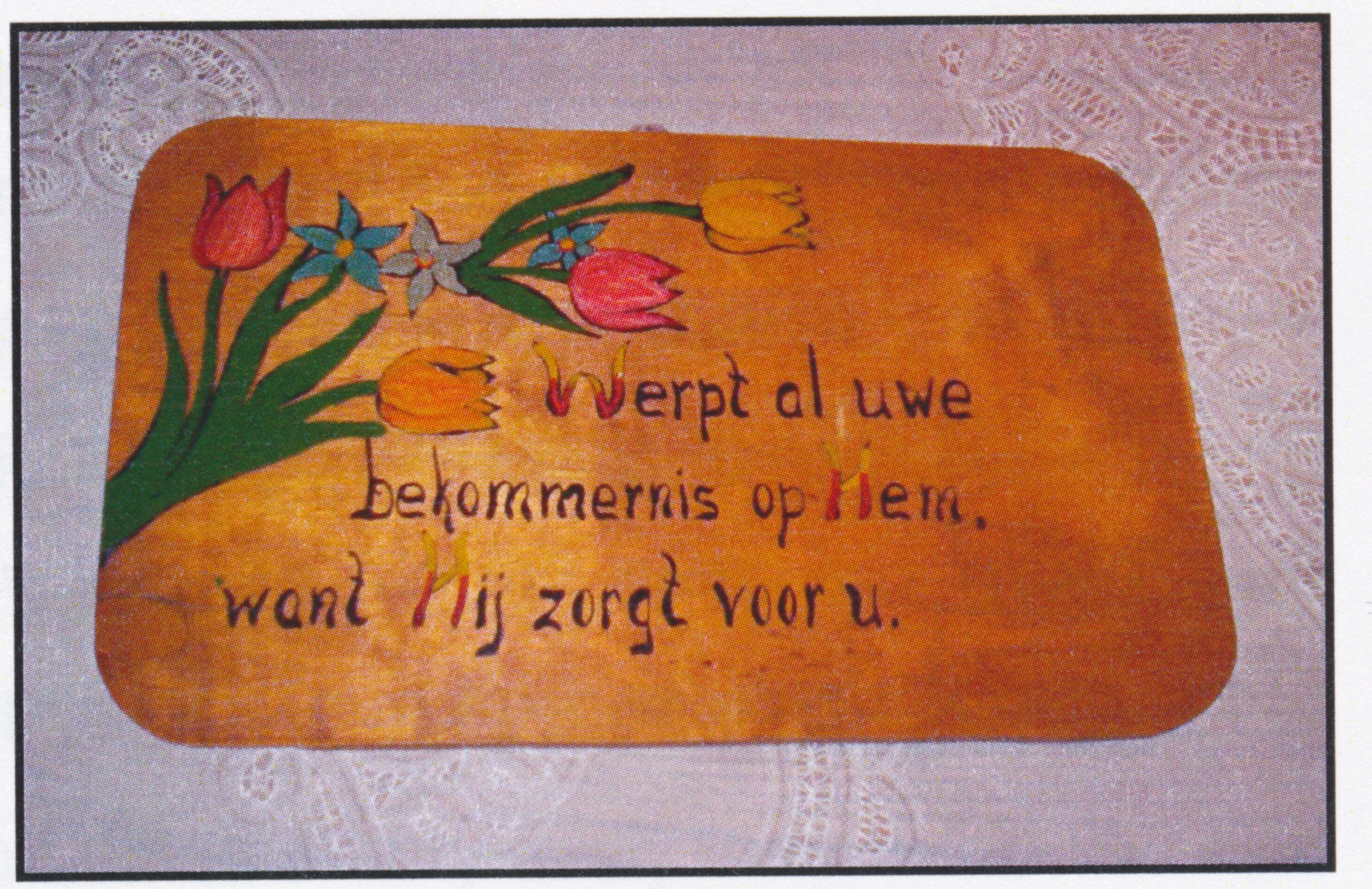
“As noted before, our parents had a real hard time. Not so much for themselves, but especially for their children. I often saw mother’s worried face light up when we came home for a few days. Not far from our home was a small bookstore and in the display window was a wooden plaque with a bunch of flowers painted on it, as well as the Bible text from 1 Peter saying: ”Cast all your anxieties on Him and He will give you rest.” Every time I walked past the store, I stopped to admire the plaque’ beauty and the message on it. It was a very expensive item, worth many weeks of meager pay but I managed to save that much over a period of time. I finally was able to buy it for my mother so she could read it every day of that terrible time and find comfort from it. When my parents died, both in 1978, I brought that plaque from their home and have found my own comfort from it. I am sure my mother would have wanted me to have it.
“I do not remember how we got there, but the last few weeks of the war, we ended up in the Village of Rottevalle, some 20 minutes by bike from where we lived. Brother Pieter was by now also in that dangerous age frame so we went together. We stayed with the family Hepkema at the end of a dead end pathway fronting on a narrow canal joined up with the Lake named The Lyen. Like us, our hosts were poor and we tried as much as we could to help out and in this case that it was not hard. You see, Mr. Hepkema, owned an old scow (large version of a rowboat) and in the lake, not too far away, were a few islands with trees and deadwood. Some mornings, we would leave very early, before sunrise, for one of the islands (about 30 minutes away). We would chop down some dead trees until there was a boatload of wood and then we would spend the rest of the day fishing. Remember that at that time, the allies had air supremacy and they would fire at anything that moved. A large scow on a clear lake, of course, would make a perfect target. So, we would wait until it was just about dark to go back. Everyone would be so happy to see us with our boat load of wood and a large meal of fish.
“And then, the end came.
“Wild rumours were heard all along but we did not know what to believe. We stayed cautious and out of sight as much as we could. Somehow, we were home on the date of liberation. Suddenly a small group of retreating, but well-armed German soldiers came into town with a horse-drawn wagon on which lay one of their comrades, severely wounded, and they stopped in front of the local doctor’s office. Dr. Folkerts treated the wounded while we watched from a distance. And that was good. As much as we hated the oppressors, we realized that our loyal doctor had to adhere to his oath to help the sick and wounded. And he did.
“Later that day, the Germans surrendered to the Canadian Army unit. That same afternoon, a Canadian Gun Carrier patrol rolled into town and guess who was sitting on the fenders? Brother Pieter and his friend Henk Kooy. We will meet them again on later pages. Also, on that day, the local underground came out of hiding with their ”hidden” cars and guns and declared the town liberated. Some of the hated collaborators were arrested.
“What a day it was!! Old Dutch flags, many with orange manners, were displayed. Orange was the name of the Dutch royalty at that time and still is today. And so that dark age that had descended on Holland and Europe in 1939 ended in May 1945. The first few days were days of feasting and happiness and bewilderment. No curfew! We could go anywhere! Many items were still scarce of course, but thanks to God and the Allied armies, we had regained our freedom period
“Now, the war in Europe had just about ended. We were free, but the bombing of Hiroshima and Nagasaki had not yet taken place. The Netherlands East Indies (now Indonesia) was still occupied by the Japanese and as eager young fellows, we argued that since the Allied (mostly Canadian) armies had liberated us, it was now our turn to join the newly formed Dutch Army and liberate what was known as the Dutch East Indies. Of course, we have not the slightest of idea of what we were getting into.
“Enthusiasm can have a somewhat blinding effect, but without it, the world would come to a standstill and nothing of importance will ever come to pass. But I often wondered how our mother and dad felt. Our family had come through those war years sort of unscathed and now two of their sons joined up for army training and a future that was far from certain. In our young bravado, we probably did not even think of that and we surely were not aware of the stress and danger our Allied liberators had endured and that we were about to face.
“Thus, sometime in June 1945, we “joined up”. Brother Pieter (now in heaven), friends Henk Looy (now near Edmonton), Ben Kempenaar (now in Bradford area) and myself. We were the first group of our village to go and as we found out later, we were part of the very first contingent of about 24 volunteers to leave the province of Friesland. I still have the newspaper clipping my father kept for us.”
Cecil Kielstra’s story continues with his enrolment in the Dutch army, and his experiences overseas. To read on, click the button below.
Cecil Kielstra’s war service overseas