
It was on April 22, 1915, at the Second Battle of Ypres, that Lieutenant Arthur Lodge Lindsay was killed in action at Kitcheners’ Wood during the Battle of Gravenstafel Ridge. Lieutenant Lindsay was a member of the 16th Infantry Battalion, within the 3rd Canadian Brigade, within the 1st Canadian Division, as part of the Canadian Expeditionary Force.
According to documents describing the events on April 22nd, it is highly likely that Lt. Lindsay was killed at or about 11:46 p.m. That is the time when he and 800 other members of the combined forces of the 10th Battalion of the 2nd Canadian Brigade, and the 16th Battalion (Canadian Scottish) of the 3rd Brigade were formed up and sent forward in support of a counter-attack to close the gap created in the line after the Germans had released chlorine gas – sometime between 4:00 and 5:00 p.m.
[Source: wikipedia] “Battle of Gravenstafel Ridge (22–23 April 1915)
In the hamlet of Gravenstafel (50.891°N 2.979°E) at about 5:00 p.m. on 22 April, the German Army released 168 long tons (171 t) of chlorine gas over a 6.5 km (4.0 mi) front on the line held by French Territorial and colonial Moroccan and Algerian troops of the French 45th and 87th divisions. Although poison gas had been used before, at the Battle of Bolimów three months earlier, the gas had liquified in the cold and become inert.
German troops carried 5,730 gas cylinders, weighing 90 pounds (41 kg) each, to the front by hand. The cylinders, opened by hand, relied on the prevailing wind to carry the gas towards enemy lines. Because of this method of dispersal, a large number of German soldiers were injured or killed while carrying out the attack.
The French troops in the path of the gas cloud sustained about 6,000 casualties. Many died within ten minutes (primarily from asphyxia and tissue damage in the lungs), and many more were blinded. Chlorine gas forms hypochlorous acid when combined with water, destroying moist tissue such as the lungs and eyes. The chlorine gas, denser than air, quickly filled the trenches and forced the troops out into heavy enemy fire
A 4-mile (6.4 km) gap was left in the front line. The German High Command had not foreseen the effectiveness of the new weapon and all available troops had been transferred to Russia, leaving few reserves in the west. General von Falkenhayn, Chief of the German General Staff, had ordered the attack as a limited effort by the German 4th Army.[13] German troops advanced at 5:00 p.m., but dusk, apprehension about the effect of the gas and the lack of reserves prevented the Germans from exploiting the gap. Canadian troops defended the flank of the break-in by urinating into cloths and holding them to their faces to counter the effects of the gas. Casualties were especially heavy for the 13th Battalion of the Canadian Expeditionary Force (CEF), which was enveloped on three sides and over-extended in securing its left flank when the Algerian Division broke.
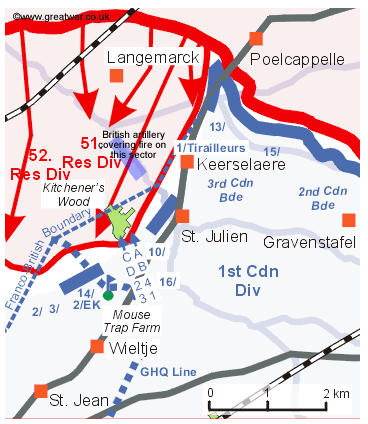
At Kitcheners’ Wood, the 10th Battalion (Alberta) of the 2nd Canadian Brigade was ordered to counter-attack in the gap created by the gas attack. They formed up after 11:00 p.m. on 22 April, with the 16th Battalion (Canadian Scottish) of the 3rd Brigade (Lt. Lindsay of Strathroy) arriving to support the advance. Both battalions attacked with approximately 1600 men, in waves of two companies each, at 11:46 p.m. Without reconnaissance, the battalions ran into obstacles halfway to their objective; engaged in small-arms fire from the wood, they began an impromptu bayonet charge. The attack cleared the former oak plantation of Germans with about 700 casualties. Lieutenant Arthur Lodge Lindsay was among them. They were unable to hold the woods, and in the morning were forced to retreat. Arthur Lindsay’s name is on the Menin Gate, Ypres, Belgium.
The Germans set fire to a chemical product of sulphur chloride which they had placed in front of their own trenches, causing a thick yellow cloud to be blown towards the trenches of the French and Belgians. The cloud of smoke advanced like a yellow low wall, overcoming all those who breathed in poisonous fumes. The French were unable to see what they were doing or what was happening. The Germans then charged, driving the bewildered French back past their own trenches. Those who were enveloped by the fumes were not able to see each other half a yard apart. I have seen some of the wounded who were overcome by the sulphur fumes, and they were progressing favourably. The effect of the sulphur appears to be only temporary. The after-effects seem to be a bad swelling of the eyes, but the sight is not damaged.”
[Source: Veterans Affairs Canada] “In the first week of April 1915, the Canadian troops (the 1st Canadian Division) were moved from their quiet sector to a bulge in the Allied line in front of the City of Ypres. This was the famed—or notorious—Ypres Salient, where the British and Allied line pushed into the German line in a concave bend. The Germans held the higher ground and were able to fire into the Allied trenches from the north, the south and the east. On the Canadian right were two British divisions, and on their left a French division, the 45th (Algerian).
Here on April 22, the Germans sought to remove the Salient by introducing a new weapon, poison gas. Following an intensive artillery bombardment, they released 160 tons of chlorine gas from 5,700 cylinders dug into the forward edge of their trenches into a light northeast wind. As thick clouds of yellow-green chlorine drifted over their trenches the French defences crumbled, and the troops, completely bemused by this terrible weapon, died or broke and fled, leaving a gaping 6.5-kilometre hole in the Allied line. German troops pressed forward, threatening to sweep behind the Canadian trenches and put 50,000 Canadian and British troops in deadly jeopardy. Fortunately, the Germans had planned only a limited offensive and, without adequate reserves, were unable to exploit the gap the gas created. In any case, their own troops, themselves without any adequate protection against gas, were highly suspicious of the new weapon. After advancing only 3.25 kilometres they stopped and dug in.
All through the night, the Canadian troops fought to close the gap. In addition, they mounted a counter-attack to drive the enemy out of Kitcheners’ Wood, an oak plantation near St. Julien. In the morning two more disastrous attacks were made against enemy positions. Little ground was gained and casualties were extremely heavy, but these attacks bought some precious time to close the flank.
The fierce battle of St. Julien lay ahead. On April 24, the Germans attacked in an attempt to obliterate the Salient once and for all. Another violent bombardment was followed by another gas attack in the same pattern as before. This time the target was the Canadian line. Here, through terrible fighting, withered with shrapnel and machine-gun fire, hampered by their issued Ross rifles which jammed, violently sick and gasping for air through soaked and muddy handkerchiefs, they held on until reinforcements arrived.
Thus, in their first major appearance on a European battlefield, the Canadians established a reputation as a formidable fighting force. Congratulatory messages were cabled to the Canadian Prime Minister. But the cost was high. In these 48 hours, 6,035 Canadians, one man in every three, became casualties of whom more than 2,000 died. They were heavy losses for Canada’s little force whose men had been civilians only several months before—a grim forerunner of what was still to come.”
British Infantry Losses on April 22nd, 1915:
1st Canadian Division = total of 642, consisting of:
3rd Canadian Infantry Brigade = 177, consisting of:
13th Battalion = 3 officers and 42 other ranks +
14th Battalion = 1 officer and 16 other ranks +
15th Battalion = 1 officer and 24 other ranks +
16th Battalion = 3 officers and 87 other ranks (Lt. Arthur Lodge Lindsay from Strathroy was one of the casualties)
Videos available on YouTube:
For King and Empire: Baptism of Fire – The Canadians at Ypres, 1915
The Second Battle of Ypres History of the World War Audiobook
Saint Julien – Dressing Station, Kitcheners’ Wood
Last post ceremony 15 June 2015.The Menin Gate, Ypres
Menin Gate Video: Ypres (leper) Belgium – Daily Last Post Ceremony – Remembrance Day 2014
The Menin Gate (drive-through)
Weblinks to Battle descriptions:
The Second Battle of Ypres, 1915
Summary of the Prelude to the Second Battle of Ypres
Contents Page for Prelude to the Second Battle of Ypres (links to 43 pages)
Summary of the Battle of Gravenstafel Ridge: 22nd April, 5 pm to midnight
Contents Page for Battle of Gravenstafel Ridge (links to 56 pages)
3rd Canadian Brigade to organize a counter-attack at Kitchener’s Wood (22 April 1915, 22:00)
Canadians to counter-attack at 11:30 pm (22 April 1915, 22:47)
Canadian Battalions counter-attack at Kitchener’s Wood (22 April 1915, 23:50)