
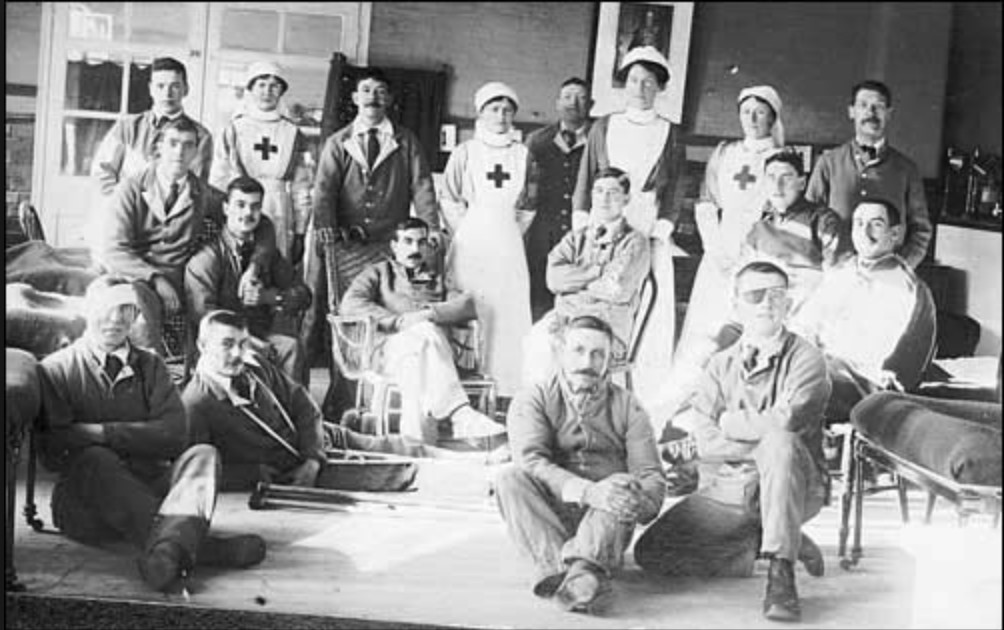
“The Voluntary Aid Detachment (VAD) referred to a voluntary unit providing field nursing services, mainly in hospitals, in the United Kingdom and various other countries in the British Empire. The most important periods of operation for these units were during World War I and World War II.
The VAD system was founded in 1909 with the help of the Red Cross and Order of St. John. By the summer of 1914, there were over 2,500 Voluntary Aid Detachments in Britain. Of the 74,000 VAD members in 1914, two-thirds were women and girls.
At the outbreak of the First World War VAD members eagerly offered their service to the war effort. The British Red Cross was reluctant to allow civilian women a role in overseas hospitals: most volunteers were of the middle and upper classes and unaccustomed to hardship and traditional hospital discipline. Military authorities would not accept VADs at the front line.”
[Source: wikipedia]

“The Voluntary Aid Detachment arrived at a pivotal time in history. The VAD was organized mainly through the Red Cross and especially in Canada through the Order of St. John. The Detachment offered an opportunity for women to participate more actively in the war effort. While working-class women would find employment in the war industries, in the field, or keeping the family business running while the men were away at war, voluntary work was not an option. Upper-class women would often choose to help raise funds or fill white-collar positions left vacant, However, that was often not enough for many of them who desired a more active role.
“The First World War had mobilized women as part of the armed forces. Nursing sisters had been professionally trained in their trade at home and received an officer rank upon joining the military. It was seen as a great leap forward by many. The creation of the VAD was then seen by many as a threat to professional nurses’ job security as well as to the respect acquired by their community since Nightingale.

“Contrary to the Nursing Sisters, VAD nurses were not trained, at least not to the same degree. They were not paid and were not subjected to military hierarchy in the same way as military nurses, as they were considered civilians. Nonetheless, they were under the supervision of the nursing sisters and their matrons. Most of them came from the upper and middle classes and this created conflicts with the nursing sisters; who were mostly from the working class. In this regard, the VAD nurses did not always accept being ordered by nursing sisters. This created resentment from the latter and the VADs were sometimes criticized for their lack of respect for military and hospital hierarchy.
“For these reasons, the military was hesitant to send VADs overseas and thus they mostly served in Canadian hospitals at homes with convalescent soldiers. Their perceived lack of regard for hierarchy and their voluntary nature made the Canadian officers uneasy at the idea of employing civilians who did not share the same culture and feared their lack of allegiance, rank, and pay might become a problem when having to take orders. As the war dragged on and the number of casualties severely increased, it became evident that VADs had to be sent overseas. VADs were in a sense an equivalent to Victorian mission workers; young women who could offer their maternalism to the good cause. Most of them came from the world of banking, clerical work, public service and even teaching. The St. John Ambulance could not hope to train nurses in a few weeks and so their role was mostly to assure that the candidates had good maternal abilities through their “well-bred nature.”

“Their duties included changing beds, feeding and cleaning the wounded or even driving ambulances. At certain times they might have also been called upon to assist nursing sisters in dressing the wounds of soldiers back from the trenches; quite a traumatic experience for many. They would also be given the responsibility of night watch on hospital wards, sometimes ending up as the sole medical staff on the floor.
“By 1920 the service was disbanded. The VADs received little public appreciation for their service. Military funeral service was arranged for those who died while serving in Europe and some regional commemorations were also organized in St. John, Newfoundland where $4000 was raised in 1920 to erect a monument for the 60 Newfoundland VAD women who served in the war. Most of these women returned to their prior lives and remained quite discreet about their involvement. Recently their story has received increased attention by the academic community and possibly that their role will, in turn, receive further public recognition.”
[Source: Museum of Health Care Blog]