
Enlistment #R221011
Air Gunner
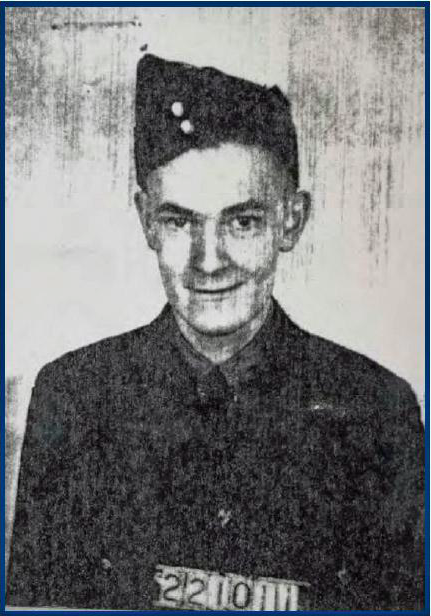
Charles Franklin Adair was born on January 4, 1925, in Hamilton, Ontario. He attended Maitland Street School for seven years, and Strathroy Collegiate Institute for one year. In his spare time, he enjoyed making model planes, playing golf and baseball. He was not married. From 1939 to 1942, Charles worked as a machine operator at the Sommerville Company, London Ontario, and briefly at Ford Motor Company in Windsor before enlisting with the Royal Canadian Air Force. Charles was one of four brothers who enlisted, three of whom never returned.
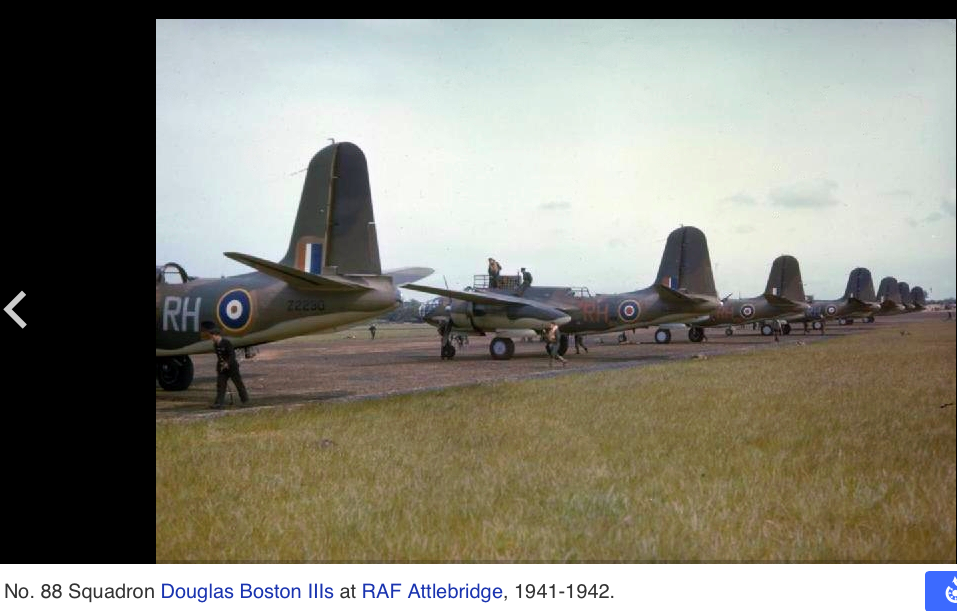
He received training in Regina, Saskatchewan, and Brandon, Manitoba before going overseas. Charles’ service number was R-221011, and he was a Sergeant Air Gunner in #88 Hong Kong Squadron. In these videos (part 1 / part 2 / part 3) you can see the position of the air gunner at the nose of the aircraft, and behind the pilot cockpit, dangerous positions!
He was killed in action on September 9, 1944, when his Boston aircraft (#BZ 416 he’s #129 on this link) was shot down over Boulogne, France. Two other members of the crew, Flying Officer Robert J. Calford and Flying Officer Mervyn Emsig, were also killed. A fourth member of the air crew, Sergeant A. J. King was taken as a prisoner of war.
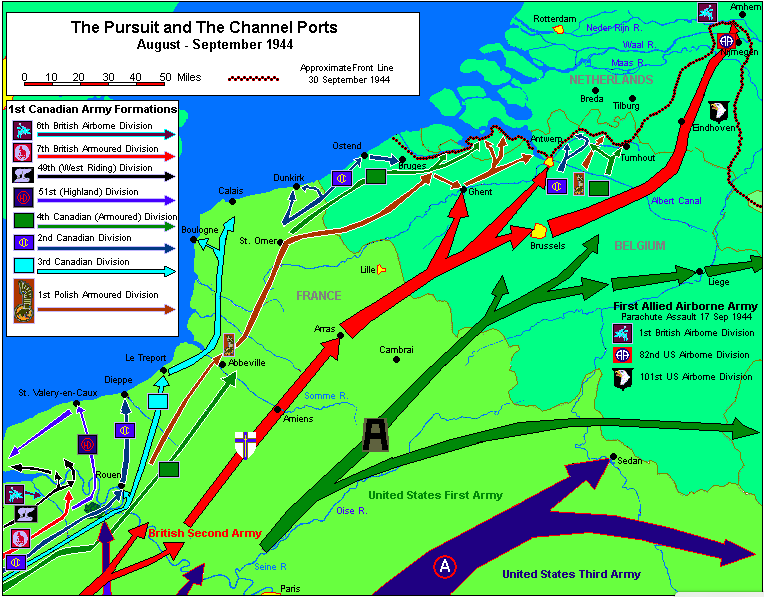
Ground attacks are usually supported by artillery fire and aerial support. In 1944, in the time period between the Battle of Normandy and the Battle of the Scheldt, there was a drive to open up the ports along the English Channel between England and France so that materials and personnel could be landed.
Here is some background of what was happening in the Channel Ports region. Air gunner C.F. Adair and his flight crew members would have been providing aerial support for this operation when they were shot down.
Channel Ports
The “Channel Ports” were a number of defended French cities along the English Channel. The term “Channel Ports” is being used on this website to refer to all fighting experienced by the Canadian Army in the period between the Battle of Normandy and the Battle of the Scheldt, during the month of September 1944.
Strategic Background
August 1944 saw the end of the Battle of Normandy, and the achievement of a major objective of Operation OVERLORD – reaching the line of the River Seine. This objective was met in advance of the original D+90 deadline (4 September 1944). The landings in Southern France had placed the US 7th Army (soon to be joined by a French Army to create the 6th Army Group) on the extreme right flank of the Allies’ “broad front” advance. At the start of September 1944, they were advancing on the Belfort Gap. To their left, the US 3rd Army advanced on Metz and the Saar region. The 1st US Army, to their left, drove on the German city of Aachen and the Ardennes Forest in Belgium, and to their left the British 2nd Army set its sights on Belgium. On the far left flank of the Allied advance was the First Canadian Army.
First Canadian Army had not yet appreciated German intentions re: the Channel Ports – air reconnaissance actually reported Boulogne, Calais and Dunkirk “deserted”.1 The Germans themselves did not have a firm intention until 4 September, when Hitler personally ordered the Channel Ports defended. While he had long intended certain French ports be designated “fortresses”, notably U-Boat pens and deep water ports in Brittany that would have been of great use to the Allies, the policy was applied wastefully to lesser ports and even the Channel Islands, where a great many German soldiers were to languish until the end of the war.
However, in early September 1944, this policy made military sense, and Allied military operations – as well as logistical concerns – were affected by the need to reduce these German fortresses. Le Havre, Boulogne and Dunkirk were all included on this list. Hitler’s directive of 4 September 1944 read in part:
-
Because of the breakthrough of enemy tank forces toward Antwerp, it has become very important for the further progress of the war to hold the fortresses of Boulogne and Dunkirk, the Calais area, Walcheren Island with Flushing harbour, the bridgehead at Antwerp, and the Albert Canal position as far as Maastricht.
-
For this purpose the 15th Army is to bring the garrisons of Boulogne and Dunkirk and the Calais defensive area up to strength by means of full units.
-
The defensive strength of the fortresses is to be increased by means of additional ammunition supplies from the supplies of the 15th Army, especially anti-tank ammunition, by bringing up provisions of all kinds from the country, and by evacuating the entire population.
-
The commanders of the Calais defence area and of Walcheren Island receive the same authority as a fortress commander…2
As early as 3 September 1944 the need to clear the Scheldt Estuary was recognized by the Allies. Admiral Sir Bertam Ramsay – Naval Commander-in-Chief under Eisenhower at SHAEF – outlined in a telegram to Eisenhower, Montgomery (21st Army Group), and the Admiralty that “It is essential that if Antwerp and Rotterdam are to be opened quickly…It will be necessary for coastal batteries to be captured before approach channels to the river routes can be established.”3
After Normandy, the British 2nd Army made spectacular progress, capturing Amiens on 31 August 1944, crossing the Somme River, and, moving at a rate of 60 miles a day, capturing Antwerp with port facilities intact on 4 September 1944. Unfortunately, the Scheldt Estuary – fifty miles of waterways leading to Antwerp – remained in German hands. At the time of Antwerp’s capture, however, the Germans were disorganized and the estuary defences only lightly held. With Antwerp’s vital port facilities taken (with the major ports on the northern Channel coast still in German hands, supplies were still arriving on the Continent in Normandy, facilitating the need to truck them forward to the now rapidly moving front), the decision not to press on and take the Scheldt Estuary would be controversial.
-
Nothing was done on the ground, either to block the escape of the 15th German Army, or to secure the banks of the Scheldt from Antwerp to the sea. The explanation for the failure was simple. Montgomery saw a gap developing between the 15th German Army retiring north-eastwards and the survivors of the 7th Army moving east to the Siegfried Line. He ordered Dempsey’s (British) Second Army to drive forward with all strength and speed to seize the bridges over the Rhine between Wesel and Arnhem before the enemy could establish a defensive line. Airborne divisions would open the way over the main rivers which intervened.…Crerar’s (First Canadian Army) was to clear the coastal belt, then remain in the area of Bruges-Calais until there were enough supplies for it to be employed further forward. Montgomery gave neither of his army commanders the task of opening Antwerp.”4
[Source:http://www.canadiansoldiers.com/history/campaigns/northwesteurope/channelports.htm]
Charles was 19 years of age when he died. He is buried at the Calais Canadian War Cemetery in Leubringhen, Pas de Calais, France.
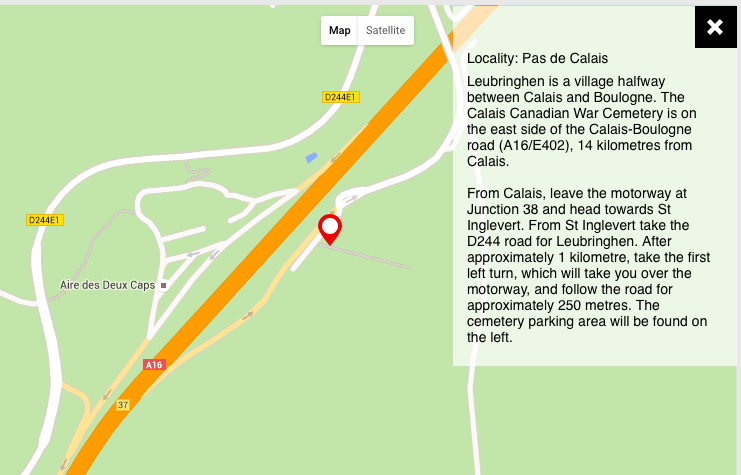
Directions to Leubringhen Canadian War Cemetery

