
Enlistment # A-21239
Corporal
There were four Adair brothers: Frederick, Robert, Kenneth, and Charles. They lived on North Street with their parents Frank Roy Adair and Dorothy Irene Pinkham Adair. Frank was employed by the Canadian National Railway. He was a veteran of the Great War. The boys attended school in Strathroy, and were very well known throughout the Town. All four brothers enlisted for service overseas. Frederick, Robert and Kenneth joined the Canadian Army and Charles joined the Royal Canadian Air Force. Frederick Wilfred Allan Adair, enlisted with the First Hussars in London, Ontario in 1939. He was later transferred to the Perth Regiment. Fred served overseas as a private for three years and was the only Adair boy to return home.
Robert James Adair, born in London, Ontario, worked as a truck driver in Windsor (Adelaide Twp History says he worked for Wilfred Down as a farmer) before he joined the Essex Scottish Regiment in May of 1938. He was later transferred to the Perth Regiment, 11th Armoured Brigade. 5th Armoured Division, 1st Canadian Infantry Corps.. His service number was A-21239, and he served as a Corporal for the Perth Regiment.
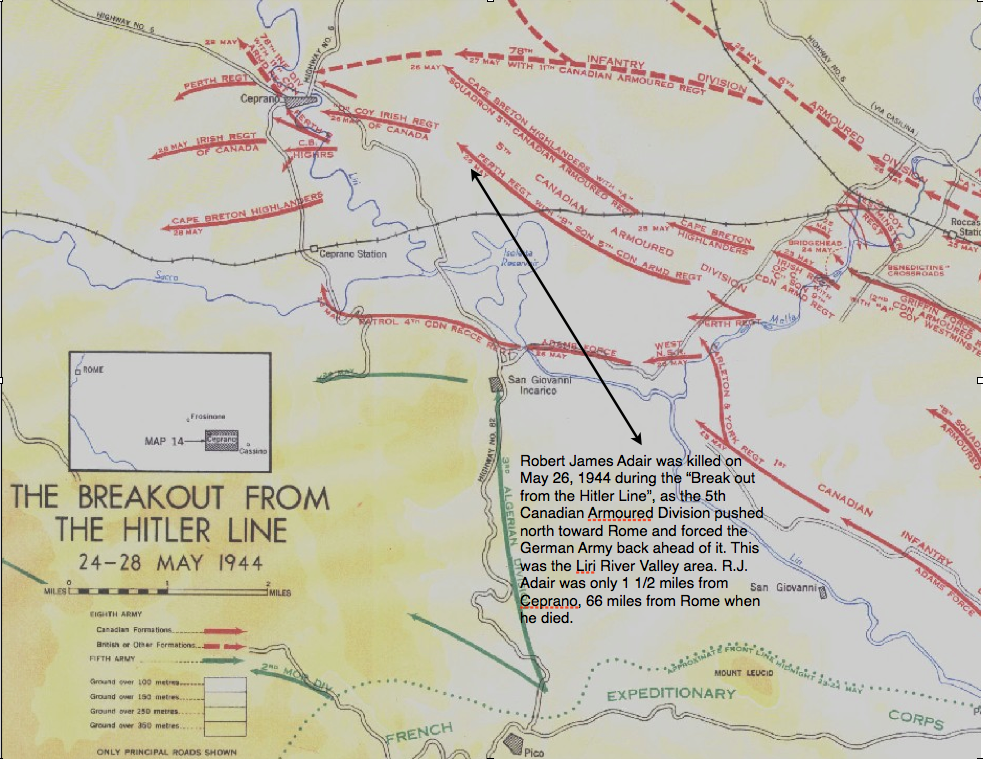
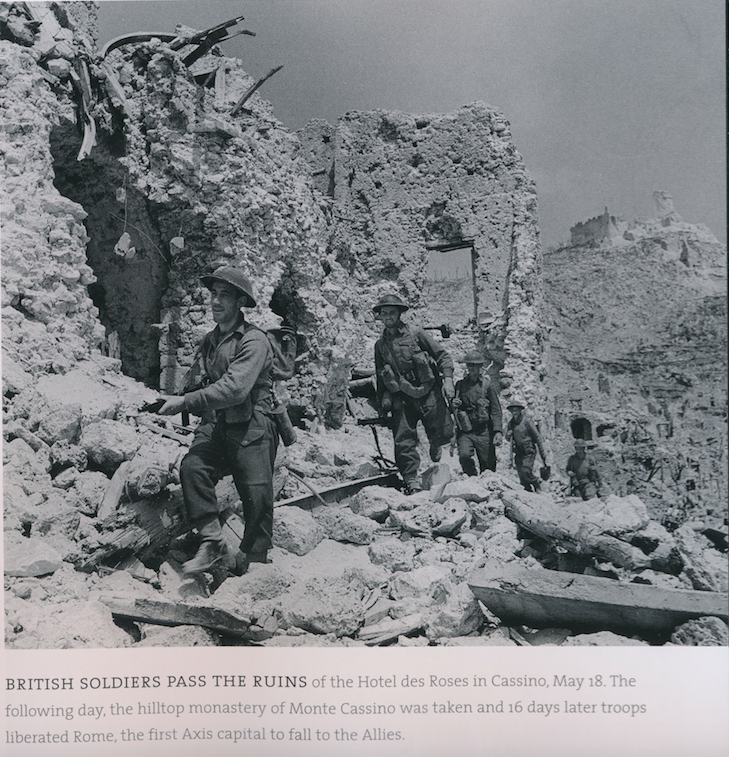
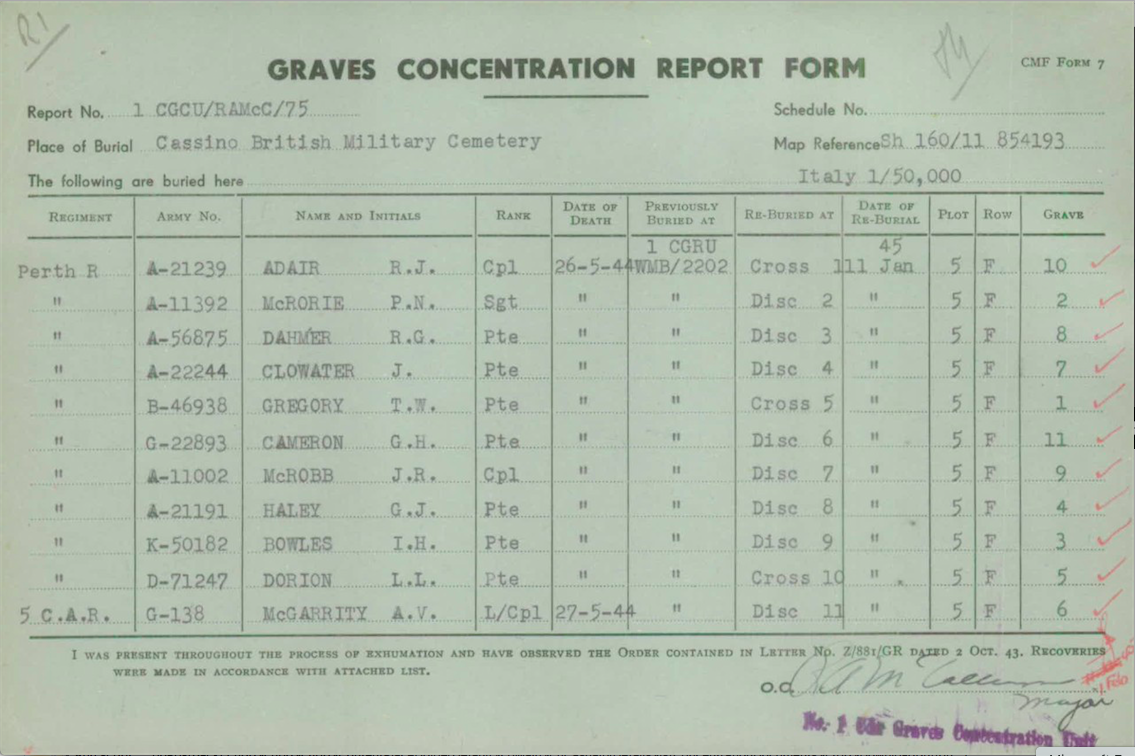
He married a British girl, Pauline Patricia Saxby, on May 1, 1943 in Crayford, Kent, England. He was killed in action on May 26, 1944 during fierce fighting in the area between Cassino and Ceprano, a key position on the Italian front. The Perth Regiment suffered heavy losses that day including 10 dead and 30 wounded.
This map shows the location of R.J. Adair when he was killed:
An excellent anecdotal record of the events on May 26, 1944 can be found in, “The Liri Valley: Canada’s World War II Breakthrough to Rome” by Mark Zuehlke, pages 377 – 384. A copy can be obtained at the Strathroy – Caradoc library.
Here is another anecdotal record of events just before, during and following the time when Robert Adair was killed in Italy:
“The Passage of the Melfa
The second phase of CHESTERFIELD the break-out by the 5th Armoured Division–began with the 5th Canadian Armoured Brigade, commanded by Brigadier J. D. B. Smith, driving forward to the Melfa River, the first obstacle behind the Hitler Line on which the enemy might be expected to make a stand. While the 9th Canadian Armoured Regiment (British Columbia Dragoons), supported by the Irish Regiment of Canada, secured and held a firm base midway between Aquino and the Melfa, the main striking force, consisting of the 2nd Canadian Armoured Regiment (Lord Strathcona’s Horse) and the Westminster Regiment (Motor),6 was directed against the river. With the remnants of his infantry withdrawn in disorder across the Melf a, the enemy relied on his artillery and delaying squadrons of armour to check our advance. In the angle between the railway and the east bank of the Melfa the Strathconas fought a sharp tank battle which ended in the destruction or dispersal of the German Panthers and self-propelled guns. During this fight Lieutenant E. J. Perkins of the Strathcona reconnaissance troop pushed on and got some of his light tanks across the river. He was shortly joined by “A” Company of the Westminsters, commanded by Major J. K. Mahony.
The precarious bridgehead on the far bank was now heavily counter-attacked by German infantry and tanks, but with PIATs, mortars and grenades Mahony and his men kept the enemy at bay even after half
–147–
the Canadians had fallen. The little group took 50 prisoners, killed numerous Germans and accounted for three self-propelled guns and a Panther. Although wounded in the head and twice in the leg, the Company Commander continued to control the fight with undiminished energy and determination. “The enemy perceived that this officer was the soul of the defence and consequently fired at him constantly with all weapons from rifle to 88-mm guns.” The bridgehead, “vital to the whole Canadian Corps action”, held firm in spite of all the Germans could do. Major Mahony’s distinguished gallantry brought him the Victoria Cross.7 Two months later His Majesty the King, travelling incognito as “General Coilingwood”, visited Canadian units in the Volturno Valley and invested him with the decoration.
By midnight a special composite force from the tat Division, consisting of the Princess Louise Dragoon Guards, the Carleton and York Regiment and supporting armour from the Royal Canadian Dragoons and the Three Rivers Regiment, after carrying on a running fight along the banks of the Liri, had reached the confluence of the two rivers. At first light on the 25th, this group succeeded in establishing a second bridgehead across the Melfa about 3000 yards downstream from the Westminsters. Later that same morning the Irish Regiment of Canada (drawn from Brigadier T. E. Snow’s 11th Infantry Brigade) attacked across the river to reinforce the Westminsters, and by midday the 5th Division bridgehead was firmly established on a two-battalion front. In spite of continued heavy shelling and mortaring of the whole area of the crossings, two bridges, vital to the passage of the armour, were thrust across the stream.
During the armoured division’s advance from the Hitler Line flank protection had been provided by the 3rd Canadian Armoured Reconnaissance Regiment (Governor General’s Horse Guards). All three squadrons fought almost continuously throughout the twentyfour hours, undergoing very severe shell and mortar fire. Rear parties of the enemy lingering along Highway No. 6 experienced the sting of the “recce” squadrons’ thrusts; and the regiment’s score for the day was half a dozen self-propelled guns knocked out, more than a hundred Germans killed, and as many taken prisoner.
With the 5th Canadian Armoured Division across the Melfa, the main battle of the Liri Valley was over. The operation now was a pursuit. The 6th United States Corps had broken out from the Anzio bridgehead on 23 May, and two days later had linked up with troops of the Fifth Army advancing from the South. With his escape routes through Rome
–148–
dangerously threatened, the enemy might attempt one more stand, on the Caesar Line; but his immediate concern was to get out of the Liri Valley as rapidly as possible, while at the same time seeking to delay the advance of the Eighth Army. To speed him on his way the 5th Division was directed to carry the Canadian pursuit on to Ceprano.
During the afternoon of the 25th, the 11th Canadian Infantry Brigade passed through the armoured brigade’s bridgehead to take up the chase. Resistance now mainly took the form of shelling from the enemy’s rear artillery positions and machine-gun fire and sniping by isolated groups on the wooded high ground north of the railway. [This is the action during which Robert James Adair was killed.] On the morning of the 27th the brigade reached Ceprano. Here the Liri flowed across our front, and beyond it the Sacco Valley led on towards Rome. Only one boat was to be found, but the Perth Regiment used it to ferry successive parties across and so cleared the town. General Burns now named Frosinone, well up the Sacco Valley, as the Canadian Corps’ next objective, and a race developed between the two brigades of the 5th Division to re-establish contact with the retreating enemy.
A valuable day was lost in getting the armoured brigade across the Liri, for the Engineers had bridging trouble and the diminishing front was crowding together the pursuit formations of the 13th Corps and the 1st Canadian Corps. The narrow Liri-Sacco corridor, with few roads and those in general bad, offered very inadequate facilities for the advance of two corps abreast. To make matters worse, it was necessary for the 78th Division of the 13th Corps to use the 5th Division’s bridge when it was completed. By the afternoon of the 29th, however, both General Iloffmeister’s brigades were within five miles or so of Frosinone. That night the Perths took Pofi, climbing the steep hill on which the town is built in the face of shellfire and sniping. Early next morning they entered Arnara. In this region the long level of the valley came to an end, as the ground broke into a series of razor-back hills lying athwart the line of advance. Extensive tank deployment was impossible, -and the Corps Commander therefore ordered the infantry division to take the lead. The relief of the 5th Division was effected successively by brigades in order that there might be no sudden halt in the advance. On the afternoon of the 30th, the 2nd Infantry Brigade relieved the 11th, and next day the Loyal Edmonton Regiment entered Frosinone unopposed.
The 5th Division, its part in the Canadian Corps’ victory completed, now withdrew into reserve. Its casualties–63 officers and 631 other ranks–reflected the bitterness of the past week’s fighting. General Leese sent hearty congratulations on its success in its first major action. “I am very proud”, he wrote, “to have the 5th Canadian Armoured Division in the Eighth Army”.
The end of May also brought the 1st Canadian Armoured Brigade a
–149–
very brief rest after three exacting weeks of fighting.”
[Source: https://www.ibiblio.org/hyperwar/UN/Canada/CA/OpSumm/OpSumm-9.html]
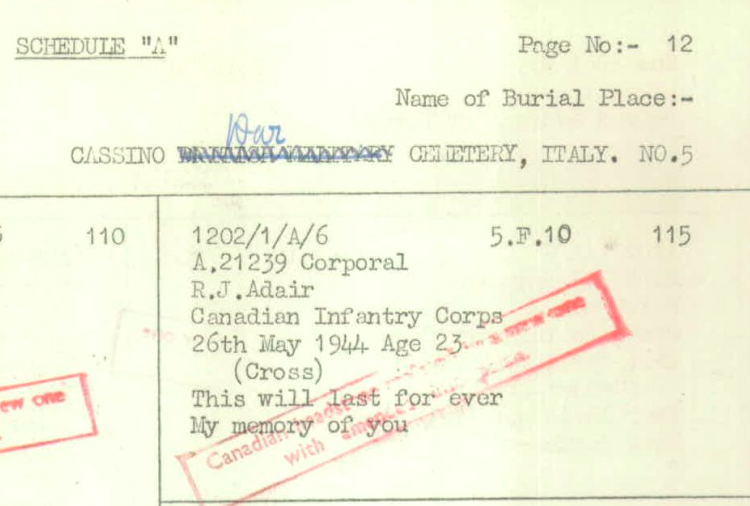
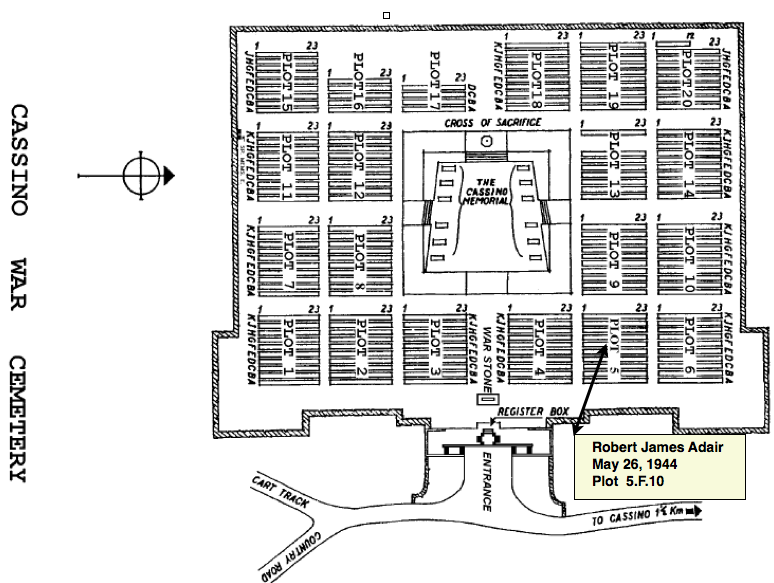
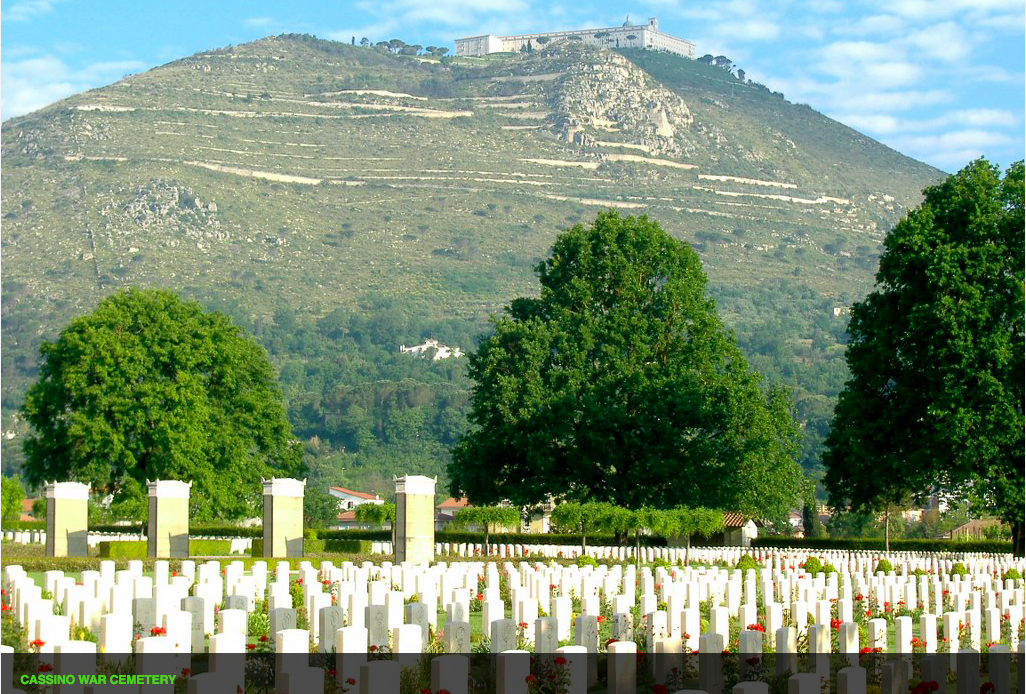
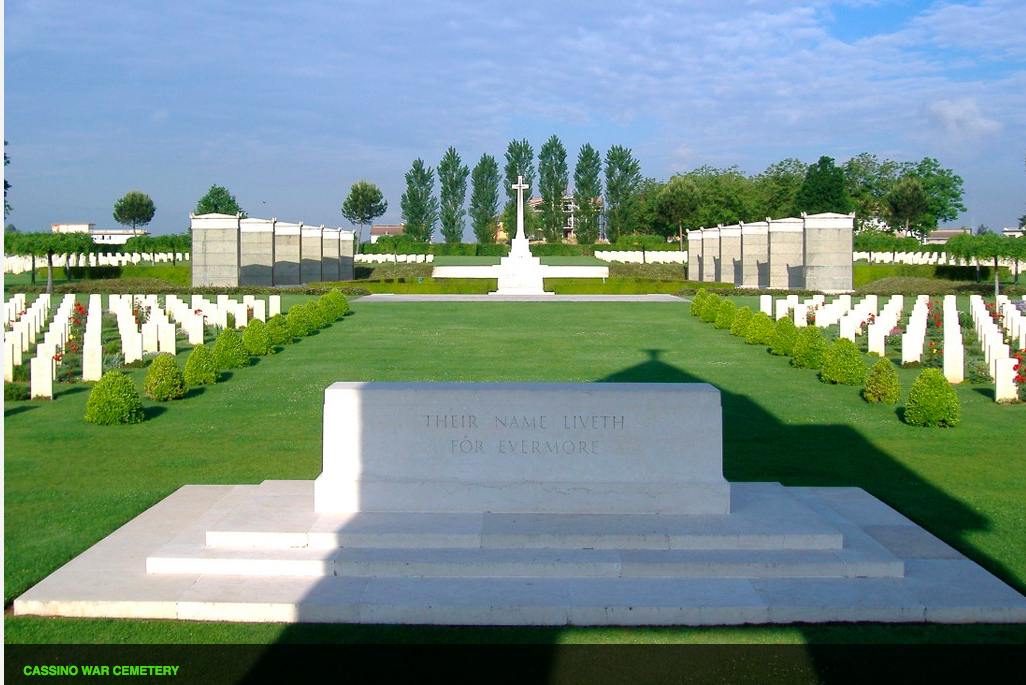
At 23 years of age, Robert was the first casualty of the Adair family. He is buried in the Cassino War Cemetery in Italy.



Adair Boulevard in Strathroy is named after the four brothers.