Home » Barker, Charles William
Barker, Charles William
Enlistment # A-19176
Lieutenant Sergeant
Charles William Barker was born on August 22, 1916 in Palmerston, Ontario to Matthew John Barker and Margaret Porter Barker. He was the fifth of nine children. His father was a veteran of the Boer War in South Africa.
Charles attended grade school and high school in Palmerston, and for several years, he worked with boats as a stationary engineer. Later, Charles went to Fergus, Ontario and worked for the Beatty Brothers dealing in household appliances. In his spare time, he enjoyed hunting with his friends. He was known for his outgoing personality, and once performed a lively tap dance routine with his brother Jim at the Palmerston town hall auditorium on amateur night.
In 1939, his family moved to London where Charles enlisted with the Canadian Army. In 1943 the Barkers moved from London to Oxford Street in Strathroy.
Four other Barker brothers were also involved in military service. Charles was a lance sergeant, service number A-19176, in the 7th Field Company of the Royal Canadian Engineers. The 7th Field Company RCE was part of the 2nd Canadian Infantry Division.
He received training in Petawawa, and was overseas by 1941. He wrote home frequently, and in his letters, he often asked his family to send him more cigarettes. Charles took part in the Dieppe raid on August 19, 1942.
Here’s a quick list of the major battles or actions that the 7th Field Company took part in (source: History of the Royal Canadian Engineers, Vol 2)
Dieppe – 19 Aug 1942
Bourguebus Ridge – 18-23 Jul 1944
St. Andre-sur-Orne – 19-23 July 1944
Verrieres – 25 Jul 1944
Falaise – 7-22 Aug 1944
Falaise Road – 7-9 Aug 1944
Clair Tizon – 11-13 Aug 1944
Foret de la Londe 27-29 Aug 1944
Dunkirk 8-15 Sept 1944
Wyneghem 21-22 Sep 1944
Antwerp – Turnhout Canal 24-29 Sept 1944
The Scheldt 1 Oct – 8 Nov 1944
Woensdrecht 1-27 Oct 1944
Walcheren “and ” Causeway 31 Oct – 4 Nov 1944
The Rhineland 8 Feb – 10 Mar 1945
The Reichswald 8 – 15 Feb 1945
Goch-Calcar Road 19-21 Feb 1945
The Hochwald 26 Feb – 4 Mar 1945
Xanten 8-9 Mar 1945
Twente Canal 2-4 Apr 1945
Groningen 13-16 Apr 1945
Oldenburg 17 Apr – 5 May 1945
So this gives you a brief look at where the 7th Field Company went.
He was killed in action on August 26, 1944 just days after the Battle of the Falaise Gap. The 2nd Division was moved eastward from Falaise into the valley of the Seine where there was heavy fighting in the Foret de la Londe against well equipped enemy troops in strength. This forest fighting started in earnest on the 27th, so Charles William Barker of Strathroy was killed the day before.
Here is some background to events leading up to Lieutenant Sergeant Barker’s death during the Battles in Normandy, France.
Summer, 1944 – Normandy
When the 2nd Division landed in France at the end of the first week of July, the beachhead had expanded little; patrol actions and defensive fighting against German armoured units had been predominant and Caen had still not fallen. As the Division assembled, the 3rd Division went ahead with Operation CHARNWOOD and finally cleared a path to the city of Caen which fell by 9 July. The role of the 2nd Division would be to push forward towards the Verrières Ridge, dominating the road to Falaise, in order to keep pressure on the Germans and drawing troops away from events further west.
Operations ATLANTIC and GOODWOOD were launched simultaneously in July, the former a Canadian affair, the latter British. Some 35 square miles of territory was seized by the Canadians, but Verrières Ridge remained in German hands. The 2nd Division’s role was a general advance south of the junction of the Odon and Orne rivers, but by 19 July, in the face of fierce resistance as well as poor weather, the division came to a halt. On 20 July, the 6th Brigade attacked the Verrières Ridge with the Essex Scottish under command; The South Saskatchewan Regiment reached its objectives but was bloodily repulsed, as were the Essex who were counterattacked. The Fusiliers Mont-Royal was similarly treated when two companies made a foothold on the ridge and few survivors were left to report. On 21 July German attacks continued against the Essex. In two days of fighting, the division lost some 300 men. A new attack by the Black Watch re-established a small foothold on the lower slopes of the ridge.
On 22 July, Montgomery decided to attack full out rather than use the operations at Verrières as a feint, and Operation SPRING – devised by II Canadian Corps – would be a three-phase operation with the same objectives as the unsuccessful GOODWOOD. The attack would be launched simultaneously with American attacks far to the west on 25 July. The 2nd Division’s attack was made over open ground, with enemy troops on the flank and in subterranean iron mines in which he took cover and from which he infiltrated the Canadian rear. The 4th Brigade attacked on the left to some degree of success, taking Verrières itself but being rebuffed at Rocquancourt. The 5th Brigade on the right suffered heavily, and the Black Watch, attacking with some 350 men to St. Andre, was reduced to some 15 survivors; out of 324 recorded casualties, as many as 120 of were fatalities. The attack continues to be the ongoing subject of bitter controversy.
21st Army Group decided now that the primary task on the Canadian front would be pinning the enemy down while the main effort would shift away from the great German strength opposite, to the British front east of the Orne. The start of August saw the Canadians (now serving under their own Army headquarters) delivering local attacks, but also saw German units – now realizing that no attack would come via Pas de Calais, as they feared – moving across the Seine and into the battle area. Armoured units opposite the Canadians were pulled out and redeployed to face the US 3rd Army. By 7 August only one German armoured formation remained on the Canadian front.
By this point, the British had made progress at the Vire and Orne Rivers, and the Canadians were ordered forward to Falaise. On 7 August, Operation TOTALIZE went forward, with heavy bomber support and the infantry using for the first time in history fully tracked armoured personnel carriers. While the 3rd Canadian Division attacked east of the Falaise road, the 2nd attacked to the west under cover of darkness. The newly arrived German Infanterie Division 89 fought hard but the defensive line that had held out for two weeks was finally breached, and the heights of the Verrierres Ridge were finally seized. The second phase saw two armoured divisions – including the newly arrived 4th Canadian (Armoured) Division – pass through. Stiff fighting brought the Canadians to a halt – by 11 August, eight miles had been gained, but eight still remained between the Canadians and Falaise.
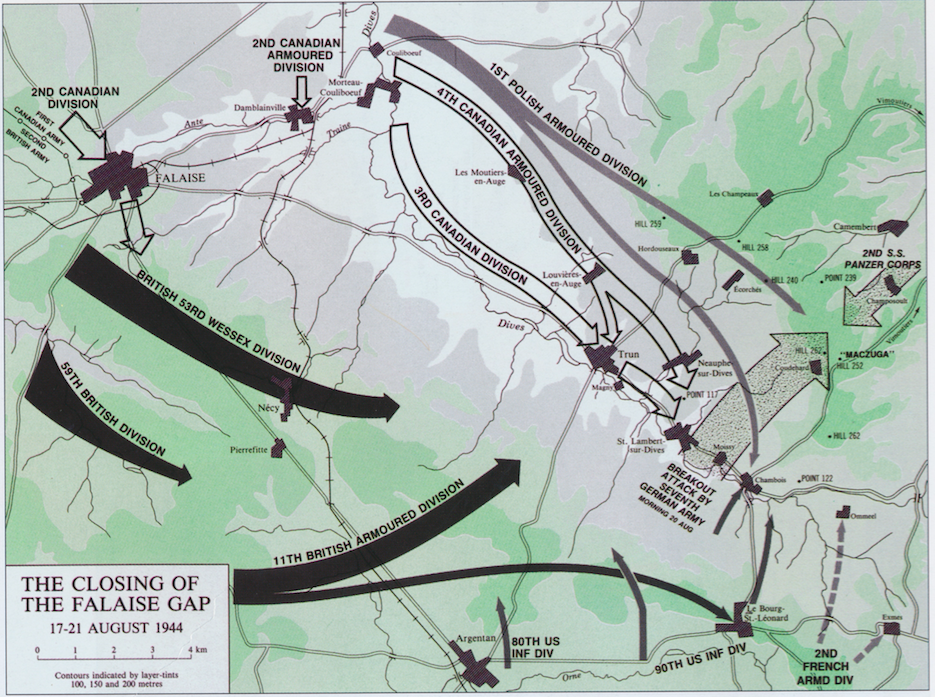
The German armour that moved away from the Canadian front was used to launch a desperate counter-attack towards Mortain beginning on 6 August. The attack ground to a halt within a day, and the Canadian advance on Falaise worried the German Field Marshall in command, who was prohibited by Hitler personally from redeploying his troops. The opportunity to encircle large parts of the German Seventh Army now presented itself, as US armour rolled towards Argentan from the south. The Canadian Army was ordered south; while the armour made its preparations to move on the 14th, the 2nd Division busied itself with preparatory attacks, crossing the Laize River at Bretteville-sur-Laize and southward for two days, recrossing the river at Clair Tizon and threatening the main German defensive line along the Falaise Road.
German capture of Canadian battle plans allowed for effective defences to be in place east of the road. Operation TRACTABLE was patterned after TOTALIZE, except that instead of using darkness for cover, artillery would provide smoke screens and abandon a preliminary barrage in hopes of maintaining surprise. The Second Division did not have a part to play in this operation, however divisional troops entered Falaise on 16 August. By this time, the Germans had realized the trap was closing, and long columns began fleeing through the gap, exposed to Allied artillery and air power.
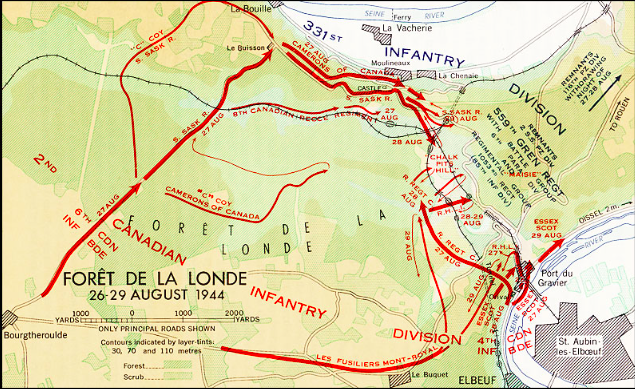
Second Division then moved on 21 August, shifting eastward, into the valley of the Seine, where hard fighting in the Foret de la Londe awaited the 4th and 6th Brigades. Fierce forest fighting lasted from the morning of 27 August to the afternoon of 29 August against well equipped enemy troops present in strength.
August had been a pivotal month. Not only had the German 7th Army been virtually destroyed, but Allied landings in the south of France were coupled with the fall of Paris. The future looked bright, and as early as 20 August, all eyes turned northwest to that familiar stretch of coast which would be forever linked with the division. First Canadian Army was advised by an order on that day from 21st Army Group “I am sure that the 2nd Canadian Division will attend to Dieppe satisfactorily.”
[Source: http://www.canadiansoldiers.com/organization/fieldforces/casf/2nddivision.htm]

Here is a more detailed description of circumstances and events around the Battle at Foret de la Londe:
Forêt de la Londe
Forêt de la Londe was a Battle Honour granted to units participating in the battle to clear this feature during the drive to the River Seine. This was the final battle of the initial campaign the Canadian Army fought in North-West Europe during the Second World War.
Background
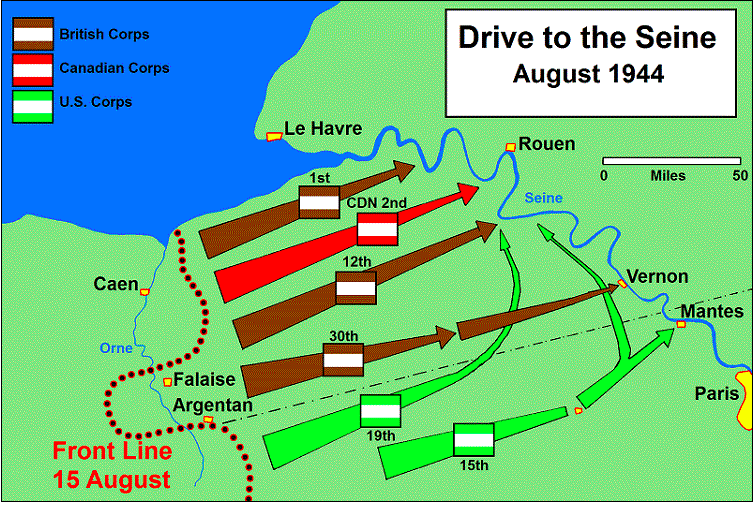
Following the defeat of the German Armies in the Falaise Gap, General Montgomery’s plan for the pursuit of the beaten army was to get Allied forces across the River Seine with great urgency, if possible effecting a second encirclement, with U.S. forces cutting off forces by sweeping up the left bank of the river. First Canadian Army was ordered to cross the Seine and clear the Le Havre peninsula, and the port itself. On 19 August, General Crerar, commanding 1st Canadian Army, issued orders to the two corps under his command and by 23 August the Army was fully on the move: 1st British Corps on an axis Lisieux-Pont Audemer and 2nd Canadian Corps along the line Trun-Vimoutiers-Orbec-Bemay-Elbeuf/Louviers. The British experienced heavy fighting, particularly at the River Touques, but by the 24th were across the River and advancing on Honfleur while 2nd Canadian Corps captured Bernay the same day, advancing against mostly “insignificant” opposition with the 2nd Division on the left, the 3rd Division in the centre and the 4th Division on the right. The corps armoured corps unit, with the divisional reconnaissance regiments, led the advance.1


The 2nd Canadian Division
The 2nd Division faced the heaviest opposition during the drive to the Seine, as their objectives were considered the most vital by the Germans. In their zone were positions covering the crossings at Rouen.
The Germans held exceptionally favourable ground. The open end of the sackshaped loop at the top of which Rouen stands is an isthmus roughly three miles wide, covered by the eastern end of the rugged area of thick woodland known as the Forêt de la Londe. Parts of this largely uninhabited region rise as high as 120 metres above the river. Just west of the narrowest point of the isthmus, the forest is intersected by a valley similar to an old river-bed, running from near Moulineaux on the north to Port du Gravier on the south. This depression carries two railway lines which traverse it with the assistance of four tunnels. On the high ground immediately east of it the Germans had disposed their main forces.
If only because the enemy’s operations were necessarily on a basis of short term improvisation, they presented a difficult problem to our Intelligence, which at first underestimated the German strength in the forest. A 2nd Canadian Corps intelligence summary issued on the night of 26-27 August described the enemy troops still “putting up stiff resistance” south of the Seine on our left flank as “nothing more than local rearguards”. [NOTE: This area, “on our left flank”, is where the 2nd Division – of which the 7th Field Company RCE was a part – was located. It was very likely that at this time W.C. Barker of Strathroy was killed.] A 2nd Division summary sent out in the afternoon of 25 August contained the statement, “Civilians report large concentration of tanks early today in Forêt de la Londe”, but this report was evidently considered to have been discredited, since a revised version issued five hours later omitted it. The division issued no more summaries until the night of 27-28 August. On the basis of the information available, the G.O.C.’s appreciation early on the 27th was, “Boche has pulled out, and little opposition can be expected.” The division’s reconnaissance regiment was accordingly ordered to push forward to Rouen. It was soon checked.
Incomplete records make it difficult to reconstruct the progress of planning, but at one stage the intention apparently was that the 6th Brigade should clear the Forêt de la Londe of such enemy as might be present, while the 4th and 5th crossed the Seine at Elbeuf, alternating with the brigades of the 3rd Division. But the ultimate decision was to attack the forest on the morning of 27 August with the 4th Infantry Brigade on the right and the 6th on the left. The final plan settled upon for the 4th Brigade was that it would advance through Elbeuf with The Royal Hamilton Light Infantry leading, followed by the Essex Scottish; The Royal Regiment of Canada was in reserve. The two leading battalions were to seize the high ground overlooking the river north of the hamlet of Port du Gravier, and the Royal Regiment was to pass through and take up a position just south of Grand Essart. In attempting to carry out this plan the brigade ran into the enemy’s main positions and made little progress.2
[Source: http://www.canadiansoldiers.com/history/battlehonours/northwesteurope/foretdelalonde.htm]
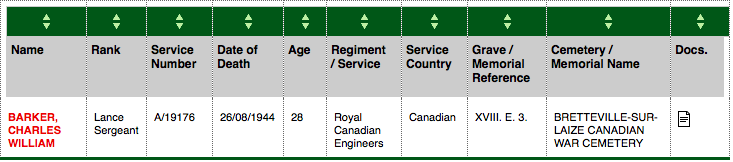
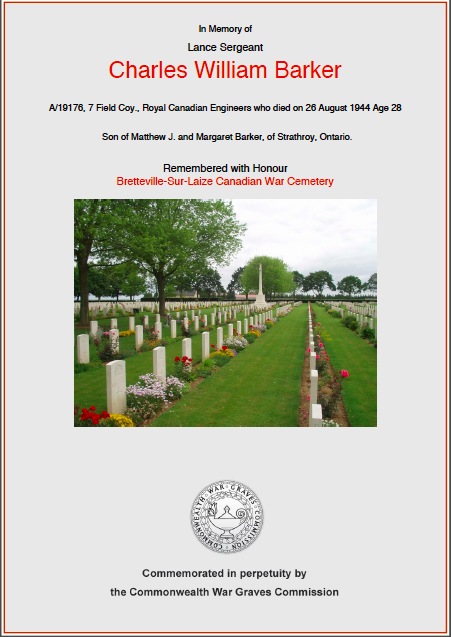
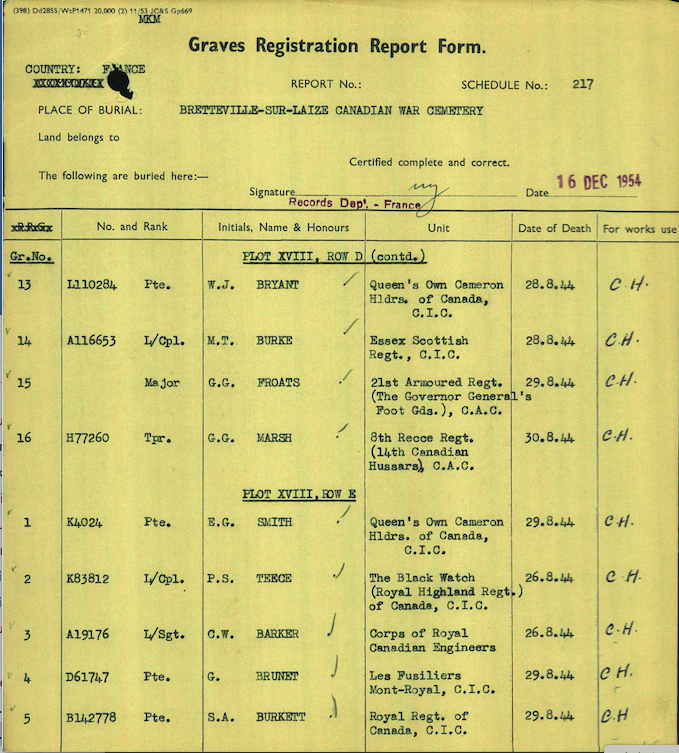
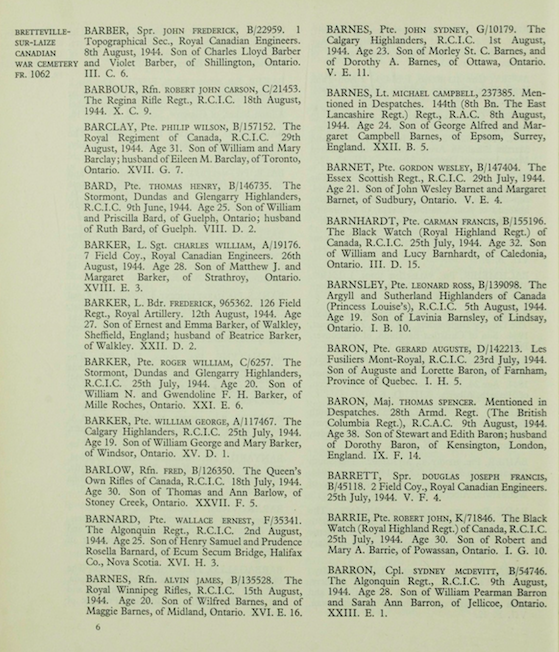
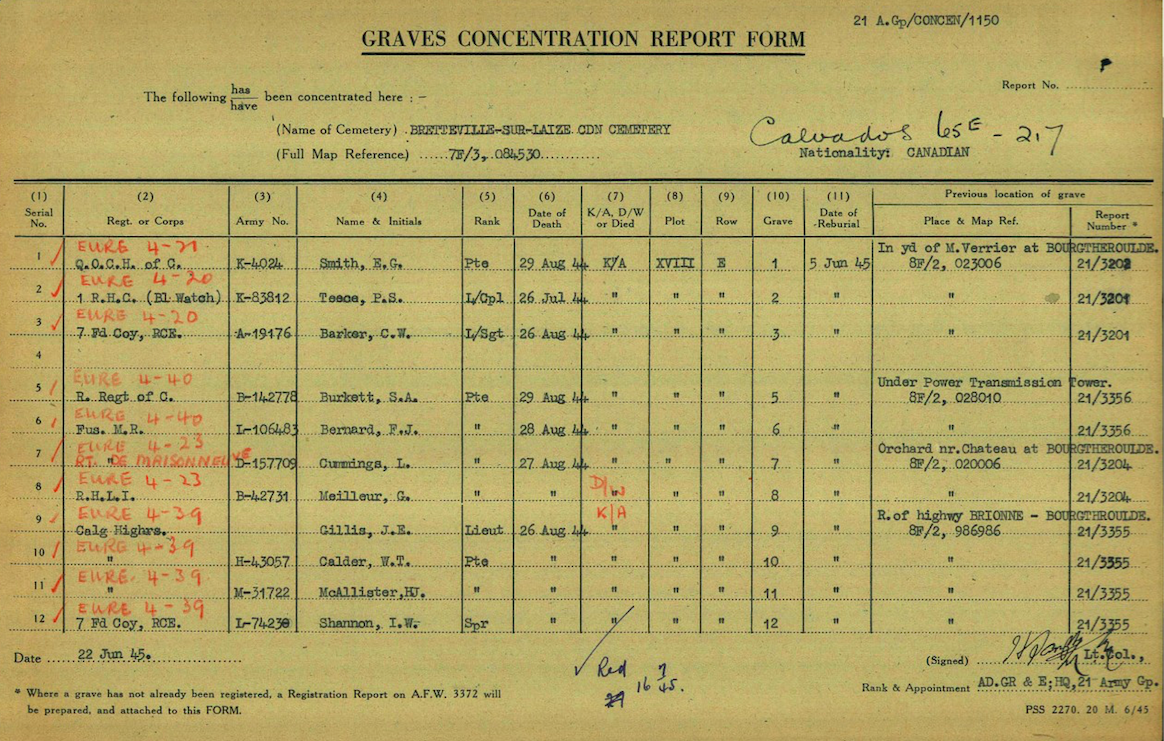
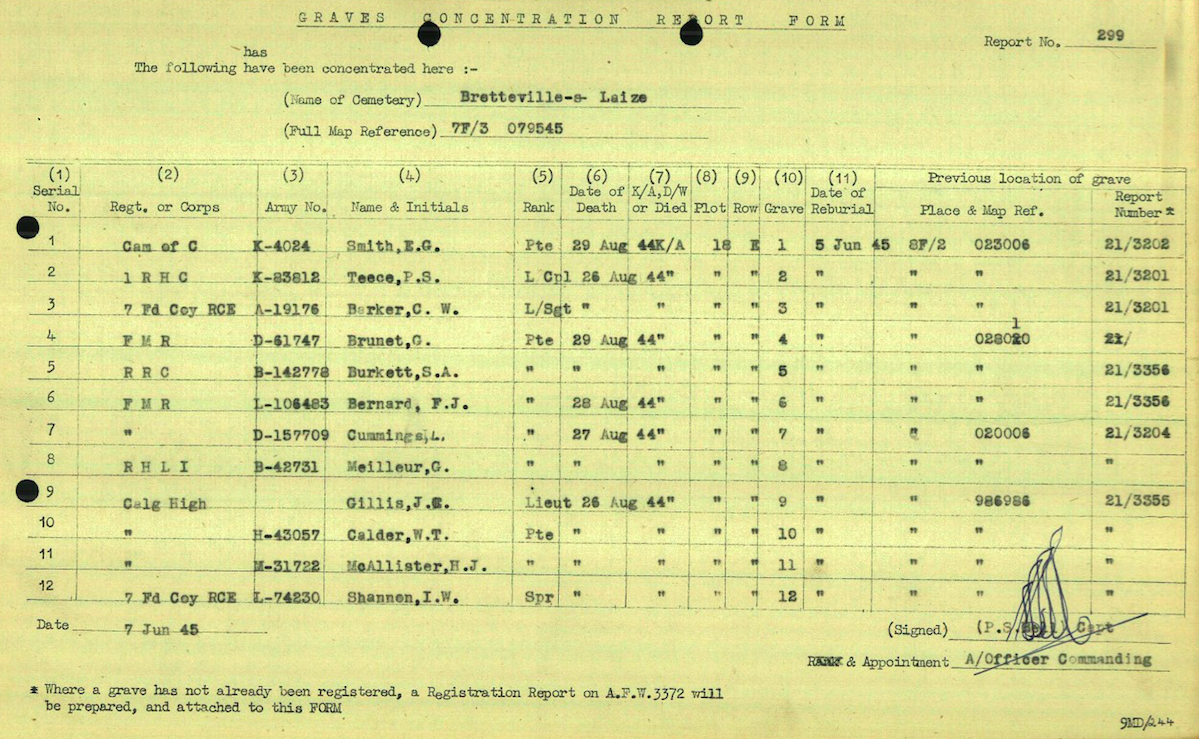
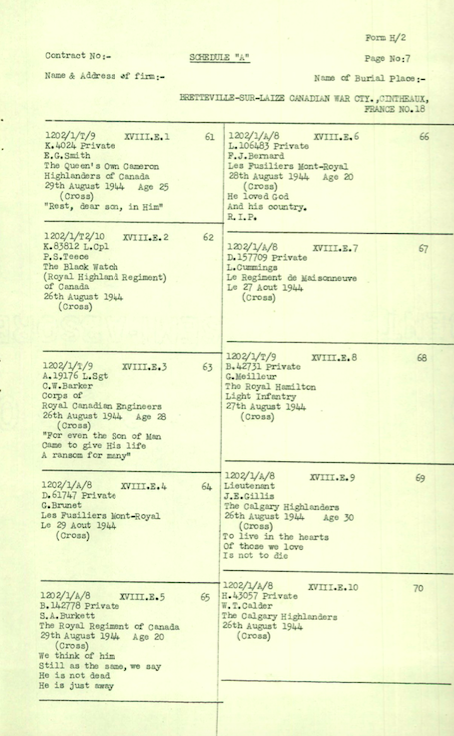
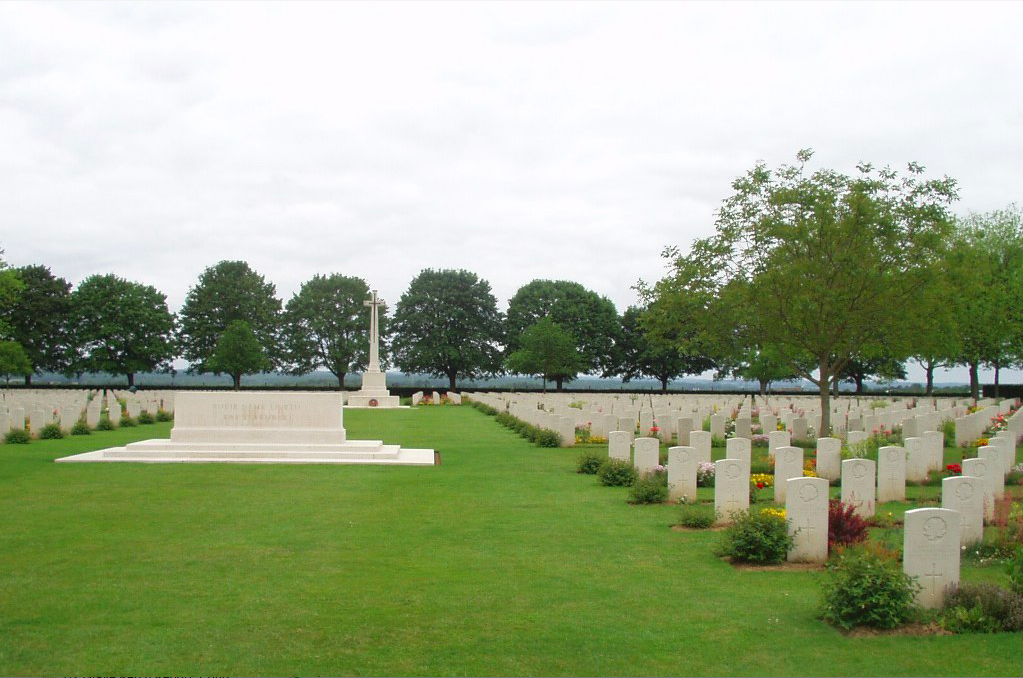
Charles was 28 years old when he died. You can see on the “Graves Concentration Report Form #299, below, that there were several other men killed that day. As was usual during the often chaotic conditions of battle, C.W. Barker – along with many others – was buried temporarily near to where he was killed. He was later reburied, on June 5, 1945, in the Bretteville-Sur-Laize Canadian War Cemetery in France. His family chose special wording that is engraved on his tombstone (see below).